
Zero-Excess Car Rental in Phuket
Zero excess means that if the car gets damaged, you do not pay the fixed slice of the repair bill that a normal policy leaves with the renter. It does not work everywhere and it does not cover everything: the exclusion list, not the name printed on the package, decides what happens after the first scratch.
Updated 13 September 2026
- Delivery to your hotel and the airport
- Answers in chat, no phone calls
- We go through the insurance before you sign
What zero excess actually means
Compulsory insurance in Thailand covers harm to other people and their property. Everything that happens to the rented car itself sits in a separate package, and that package is where the excess lives — a fixed amount the renter pays before the insurer pays anything at all. Take that amount down to nothing and you get what the market calls zero excess, full cover, or super CDW, depending on who is writing the listing.
The exclusion list is the real document
The interesting part is never the headline. It is the paragraph that lists what the package will not touch: glass, tyres, wheels, mirrors, the underbody, the interior, keys, and anything that happens off tarmac. Those exclusions are close to standard across the island, and they cover the damage a visitor is most likely to cause. A stone from a lorry on the bypass hits the windscreen; that is glass. A kerb in Patong scuffs a wheel; that is a wheel.
So the useful question at booking is not whether the excess is zero. It is: what stays outside the cover, and where is that written down. Ask it in the chat, in writing, before anything is signed. A screenshot of that answer is worth more than the wording on any brochure, because it names the person who gave it.
What it does not change about the car
Insurance does not change physics. A low front bumper still catches the ramp of a hillside villa in Kata. A puddle deeper than the door sill still ends in a hydrolocked engine. Brakes still fade on the long descent from the Patong pass if you ride them all the way down instead of dropping a gear. Zero excess changes who argues about the bill afterwards, not whether the damage happens.
It also does not change the conversation at the roadside. If a policeman stops you and your licence category does not match what you are driving, the cover is irrelevant — the paperwork problem comes first. The same goes for a driver who is not named on the contract. Hand the keys to a friend for one short run to the shop, and a very expensive package can turn into no package at all in a single sentence.
The practical reading is simple. Buy the cover for the risks you cannot control: a car park knock while you are at dinner, someone reversing into you at the Chalong roundabout, a scooter clipping the wing mirror in traffic. Do not buy it as permission to drive somewhere the car was never built to go.
Who does not need it
If you are taking a car for a day or two and driving a route you already know — hotel, beach, a restaurant, back — the extended package earns very little. Those trips happen on tarmac at low speed, and the exclusion list eats most of what could realistically go wrong on them. The money is better spent on a car that suits the route.
It also makes little sense for anyone who plans to spend real time off the main roads: red dirt tracks to a viewpoint, a construction access road, a beach approach after rain. That is exactly the ground the exclusions name. You would be paying for a package precisely where it stops working.
The people it does suit are the ones parking in busy places every day, driving a bigger or newer car than they are used to, or staying long enough that the odds catch up with them. On a month on the island, the wing mirror in a narrow Phuket Town lane stops being a story about bad luck and becomes a statistic.
ImportantGet the exclusion list in writing before you sign, not the name of the package. Glass, tyres, wheels, underbody, interior and keys sit outside cover on most contracts, including the ones sold as zero excess. One message in the chat fixes what was agreed far better than any conversation on the forecourt.
What to do, step by step
Before you book, ask three things: is there an excess, what exactly is excluded, and in what form is the deposit taken. Ask them in the chat rather than on the phone, because the chat is the document you will be quoting later if anything is disputed.
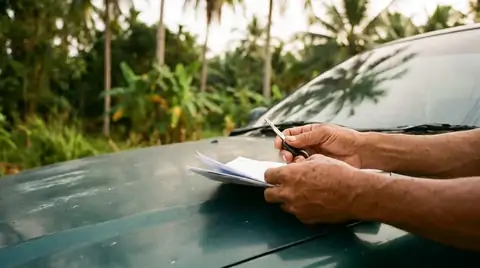
At handover, film the car yourself. Walk around it slowly with the camera running, get close to the glass, the wheels, the sills and the bumper corners, then open the doors and film the seats and the boot floor. Say the date out loud on the recording. It takes a few minutes and it settles every argument that ever starts about a mark nobody remembers.
- Ask for the exclusion list in writing — the package name guarantees nothing
- Confirm how the deposit is taken; cash and a card hold hit your budget very differently
- Put the second driver on the contract before anyone else touches the wheel
- Film glass, wheels and sills specifically — those are the parts most often excluded
- Never drive into standing water; a hydrolocked engine stays with the renter under any package
Why the deposit stays
The deposit and the insurance solve two different problems, and that is why one does not remove the other. Insurance answers for damage to the car. The deposit secures the contract itself: traffic fines that arrive weeks later, fuel returned short, a late drop-off, a lost key. None of that is damage, so no damage package covers it.
It comes in two shapes on the island. Cash is handed over and handed back, which is straightforward but ties up real money for the whole rental. A card hold blocks an amount without charging it, then releases — usually a few days after return, sometimes longer, depending entirely on your own bank rather than on the rental company. Neither is better in the abstract; they simply hurt different budgets.
Ask which one applies before you arrive, and ask what would have to happen for part of it to be kept. A company that answers that question plainly, in the chat, is telling you something useful about how it will behave at the end of the rental. Write to us on WhatsApp, or on Telegram if that suits you better, and we will walk through the cover and the deposit for your dates before you commit to anything.
Cars for this trip
See all →

Common questions
What does zero excess car rental mean?
It means the renter does not pay the fixed slice of the repair bill that a standard policy leaves with them. It does not mean everything is covered — the exclusion list still applies, and that list is the document worth reading.
What is usually not covered by a zero excess policy?
Glass, tyres, wheels, mirrors, the underbody, the interior and keys are outside cover on most contracts here. Damage from driving off tarmac or through standing water is normally excluded as well.
Do I still need a deposit if there is no excess?
Yes, in almost every case. The deposit secures the contract rather than the bodywork: fines, fuel, late return and lost keys are not damage, so no damage package covers them.
Is flood damage covered after heavy rain?
Usually not. A hydrolocked engine is treated as driver error rather than an accident, and it stays with the renter under any package, which is why the rule about standing water matters so much in the wet season.
Can I add a second driver to the contract?
Yes, and you should do it before that person drives rather than afterwards. An unnamed driver at the wheel can void the cover entirely, no matter how comprehensive the package looked when you booked it.
How do I prove damage was there before I took the car?
Film the whole car at handover with the date spoken out loud on the recording. Close-ups of glass, wheels, sills and bumper corners settle nearly every dispute that comes up on return.
Write to us — we will find the right car
We answer in chat: no forms, no phone calls, no waiting on hold.