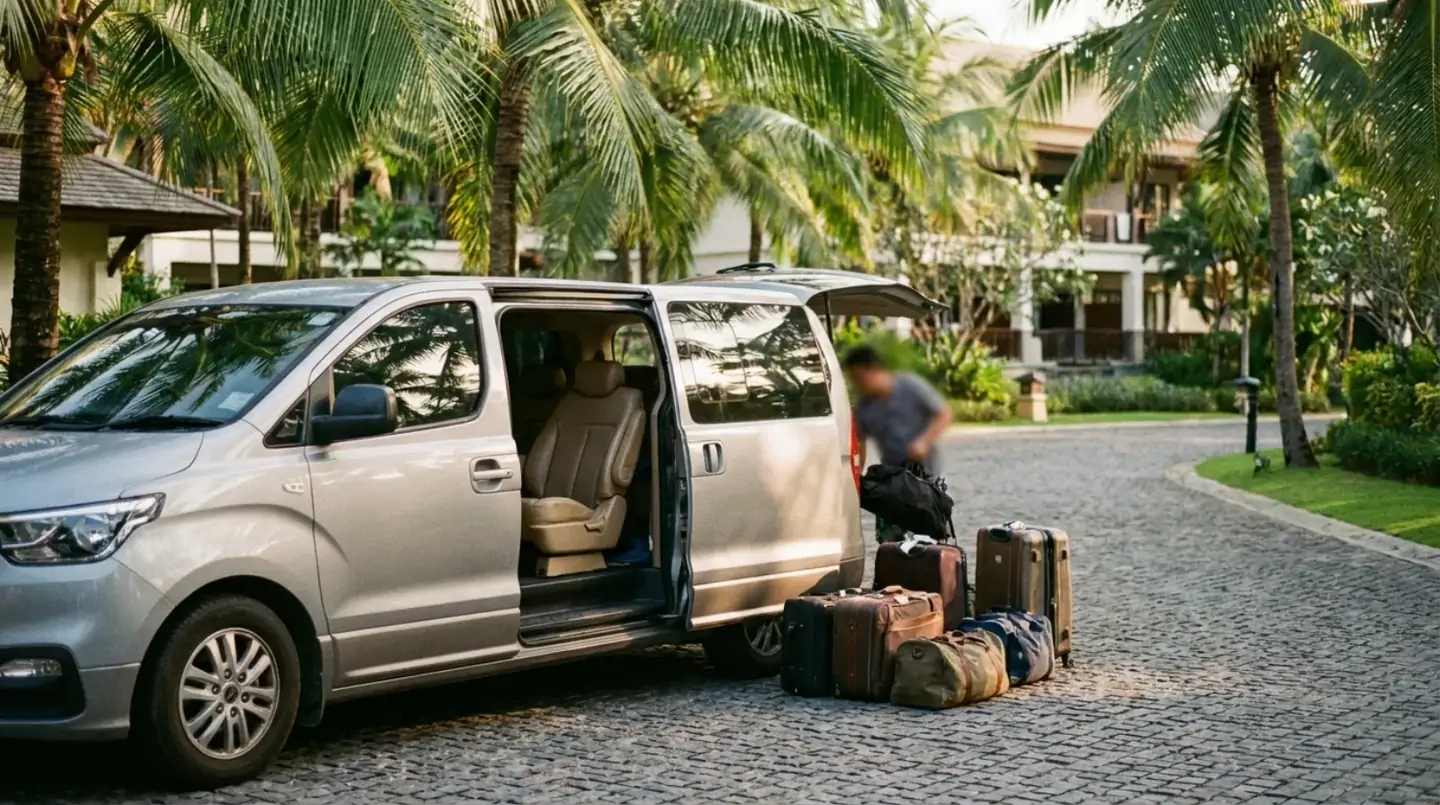
Leaving Phuket in a Rental Car
You can drive off Phuket in a rental car if your agreement allows it and the insurance keeps working beyond the Sarasin bridge, and that has to be asked before you leave rather than afterwards. It does not work when the agreement carries an outright ban on leaving the island or a mileage limit: then a trip to the mainland becomes a breach of the rental terms, with everything that follows.
Updated 13 September 2026
- Delivery to your hotel and the airport
- Answers in chat, no phone calls
- We go through the insurance before you sign
What to ask the rental company
The conversation takes a couple of minutes and removes almost every risk of the trip. The first question is whether the agreement permits leaving Phuket at all: some cars carry that restriction by default, and people usually find out afterwards. The second is whether the insurance works beyond the island, because cover is sometimes tied to territory.
Five questions worth asking out loud
Is there a mileage limit and what counts as exceeding it. Who recovers the car and how if it fails on the mainland, since companies rarely send their own truck that far and work through partners instead. Does the trip have to be announced in advance and in what form. Is there a second set of keys and where is it kept. Get the answers in writing in the chat, because a dispute a week later is won by whoever kept the correspondence.
The second set of keys sounds like a detail right up to the moment one is locked in the boot a hundred kilometres from the office. Ask what happens then: is a duplicate brought out, or is the car opened on the spot at your expense.
ImportantLeaving without agreement voids the insurance entirely. A minor collision on the mainland while the agreement bans leaving the island is paid by the renter in full, and the deposit is the first thing used to cover it.
How the exit works
Phuket is joined to the mainland by the Sarasin bridge at the northern tip of the island. There is one road to it and it is straightforward: highway 402 Thepkrasattri runs from the south through Thalang, past the airport, and ends at the bridge. Further north it reaches the junction at Khok Kloi, and that is where the route really divides.
At Khok Kloi you join highway 4, Phetkasem. East along it lies Phang Nga and then Krabi. North lies Takua Pa and Khao Lak. It is easy to take the wrong exit there, because the signs alternate between Thai and English and the turning you want is labelled with a town you are not going to.
How long the drive takes
Khao Lak is around an hour and a half at a relaxed pace, the town of Phang Nga an hour and a half to two, Krabi about three. Those figures hold if you have not caught the morning flow on the 402: the section from Kathu and Thalang towards the bridge collects everybody heading for the airport, and during departure hours it is dense. Setting off early in the morning or after lunch is the sensible option.
What it means for the car
Mainland roads differ from island ones in speed and in the length of the runs. In Phuket you rarely hold a steady pace for longer than twenty minutes, while on highway 4 you drive for hours, and the car works differently: higher consumption, more heat, and any wheel imbalance becomes obvious. A crossover is more comfortable than an economy car here not because of ground clearance but because of the seating position and stability on long straights with lorries.
Check three things before you set off that short island trips forgive: tyre pressure, coolant level and the air conditioning at idle. Look at the spare as well, not for its presence but for its pressure.
Fuel stations on highway 4 appear regularly, but there are long empty stretches between them, and on the turnings to the national parks there may be none at all. The island habit of refuelling when the light comes on works badly on the mainland. Keep the tank at least half full and do not pass a large station counting on the next one.
Before the bridge
Fill up in Thalang rather than hoping for the first station across the water. It is a two minute stop that removes an hour of thinking about it later.
Police and fines beyond the island
Checkpoints on highway 4 are more frequent than on the island, and stops there are calm and routine. The documents have to be with you: passport, a licence of the right category and the car's papers from the glovebox. The International Driving Permit is asked for, and not having it on the mainland costs more than a conversation on a beach road in Chalong.
Fines for speed and for seatbelts reach the rental company later, sometimes after you have already handed the car back. That is why the owner holds the deposit for a while after the return. If you were stopped and given a notice, say so at the handover rather than hoping the paper will disappear.
Driving on the left is the same on the mainland, but the rhythm is different. Overtakes are longer, speeds are higher, and the island assumption that everybody drives slowly does not apply.
One more thing visitors notice: the lorry traffic on highway 4 is heavy and steady, and it sets the pace. Fitting into it calmly is easier than trying to make progress through it.
Planning a day trip
Khao Lak genuinely works as a day trip: leave early, arrive by lunch, back in the evening. Phang Nga fits too, if the stops are not stretched. Krabi in a day is a bad idea: three hours each way turns the trip into six hours of driving plus everything else, and you will be coming back in the dark on an unfamiliar road.
Why darkness changes the calculation
At night on the mainland highways you meet unlit motorcycles and machinery without reflectors, and the markings are worn away in places. Coming back after dark is the main risk factor of the whole route rather than the road itself. Plan to reach the bridge before sunset.
Parking on the mainland is easier than on the island: there is almost always space at restaurants and viewpoints. The surprise comes on the other side, because the flow back onto Phuket along the 402 is often denser than the flow out, and the last twenty kilometres to your hotel take longer than you allowed.
Take water, cash for tolls and park entries, and a plan for where you will stop. Long mainland stretches have fewer places to pull in than the island has, and improvising is less pleasant at hour four than at hour one.
If the mainland is in your plans, tell us before we hand the car over. Message us on WhatsApp with your dates and destination, or Telegram if you prefer, and we will make sure the paperwork matches the trip.
Cars for this trip
See all →
Common questions
Can I drive a rental car off Phuket to the mainland?
Only if your agreement permits it, because some cars are restricted to the island by default. Ask about the insurance separately as well, since cover can be tied to territory even when the trip itself is allowed.
How long does it take to drive to Khao Lak or Krabi?
Khao Lak is around an hour and a half at a relaxed pace and Krabi about three hours each way. Those figures assume you have avoided the morning traffic on the 402 towards the bridge, which builds during airport departure hours.
What happens if the car breaks down on the mainland?
Recovery is usually handled through a partner rather than the company's own truck, which is why you ask how it works before you leave. Without an agreed arrangement you can find yourself paying for the recovery yourself.
Are the mainland highways harder to drive than island roads?
They are not harder but they are different: higher speeds, longer overtakes and heavy lorry traffic that sets the pace. Check tyre pressure, coolant and the spare before setting off, because a fault shows up differently over hours of steady driving.
Is Krabi possible as a day trip from Phuket?
It is possible but not sensible, since six hours of driving leaves little of the day and forces a return in the dark. Khao Lak and Phang Nga both work comfortably in a day if you plan to reach the bridge before sunset.
Write to us — we will find the right car
We answer in chat: no forms, no phone calls, no waiting on hold.