
Scooter Rental in Thalang, Phuket
Thalang is the inland district in the north of the island, and a bike is needed here because the distances between villages, temples and the forest reserve cannot be walked at all. The local difficulty is that road 402 runs through the district, the fastest road on Phuket, and living beside it means joining it regularly.
Updated 13 September 2026
- Delivery to your hotel and the airport
- Answers in chat, no phone calls
- We go through the insurance before you sign
What the district is and why you need a bike
Thalang is not a resort, it is the old part of the island: villages, fields, temples, workshops and markets strung along the roads. The sea is roughly equidistant in both directions, west to Nai Yang and Bang Tao, east to Pa Khlok and the bay. People live here for the quiet rather than for a beach outside the window.
What is in the district
Wat Phra Thong with its golden Buddha sunk into the ground to the waist. The Heroines Monument on the big roundabout that half the island drives past. The Khao Phra Thaeo reserve with the Bang Pae and Ton Sai waterfalls, the last real forest on Phuket. All of it is scattered over tens of kilometres, and getting round it independently means two wheels.
Everything northern is close from here: the airport, the Sarasin bridge, the beaches from Nai Thon up to Mai Khao. Going south across the whole island takes considerably longer, and that is worth weighing when you choose where to stay.
What that means for the machine
Road 402 is not a town street. It is a wide divided road carrying lorries, coaches and pickups, and traffic moves substantially faster there than on the coast. A bike feels small on it, and the outside lane belongs to whoever is overtaking.
How to join it
Coming out of a side road onto 402 takes decisiveness: build speed straight away instead of rolling out. U turns across the divider are made in dedicated pockets, and those pockets are where visitors most often get it wrong, because you have to let both directions through rather than one. If in doubt, carry on to a junction with traffic lights.
The roads inside the district are a different animal: narrow, with a verge and no kerb, and in places with earth tracks leading off to temples and fields. After rain those tracks turn to mud and the front wheel drops into a rut. The approaches to the reserve waterfalls are their own case, with a short climb, damp asphalt under the trees and wet leaves lying on it.
ImportantThe roundabout at the Heroines Monument on road 402 is the most underestimated junction on the island. Drivers joining it rarely look left, and those leaving it change across two lanes at once. Take it in the outer lane, do not try to cut across, and keep a finger ready on the brake.
Where to park
The parking areas at the Thalang temples are small, but there are few people and there is usually room. The one thing to watch is not blocking the way for local people, because these temples are working ones and villagers come to them. Park at the edge rather than by the gates.
At the reserve
There is parking at the park entrance, and from there the path to the waterfall is walked. The area is partly earth, and after rain a bike on soft ground topples on its own. Look for a concrete or stony patch, and if there is none, put something flat under the stand.
Along 402 there are large fuel stations and roadside commercial areas with proper entrances. Those are convenient places to stop: shade, water and a toilet, and you can stand there without taking somebody's space. Stopping on the verge of the trunk road itself is not worth doing at all, because the traffic is moving fast.
In the villages people park along the street. A red and white band on the kerb means no parking here too, though two wheels are challenged less often than cars are.
- At the edge of a temple yard, never by the gates
- Firm ground at the reserve car park after rain
- Fuel stations on 402 rather than the verge
- Red and white kerb applies in the villages too
Where a beginner should not ride yet
Road 402 is not the place for a first ride out, and that is the most important thing to say about Thalang. Start on the roads between the villages: they are wide, the traffic is thin, and there you get used to riding on the left and to looking right first at a junction.
The approaches to the waterfalls after rain come second. Asphalt under the canopy does not dry for half a day, wet leaves lie on it, and the gradient is short and steep. Descending that surface on a scooter is unpleasant even for people who have ridden for years.
Riding around the district at night needs working lights and a readiness for surprises. There is almost no lighting along the secondary roads, the markings fade, dogs come onto the asphalt and local motorcycles pull out without headlights. Check the headlamp and the stop light in daylight, at the handover.
TipIf you are heading to the reserve, set off early in the morning. The forest is cool before ten, the paths are not yet busy, and the ride back along 402 at that hour is the calmest it gets all day.
Documents, helmet and the handover
A bike requires category A: your national licence plus an International Driving Permit with the motorcycle entry open. Checkpoints appear on 402 more often than on beach streets, but the point is not the fines. That entry decides whether the insurance responds when a case is examined.
Helmets are compulsory for rider and passenger. Ask for the second one straight away and check whether it forms part of the deposit.
What to check in a northern district
There are more kilometres here and higher speeds than at the beaches, so look at the tyres more carefully than usual: the tread should be readable across the full width. Test both brakes before you set off, switch on the indicators and ask somebody to confirm the stop lamp lights up. Ask at the same time who pays for recovery if the bike stops far from town, because in Thalang the nearest workshop is often further away than it looks.
Delivery to a house in Thalang is straightforward and saves you a trip into a tourist district for the handover. Message us on WhatsApp with your dates and your address, or Telegram if you prefer, and say whether you will be using 402 daily.
Cars for this trip
See all →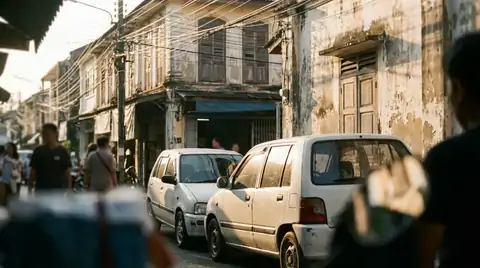

Common questions
Can you live in Thalang without a vehicle?
The district does not work without one: the villages, temples and shops are scattered over tens of kilometres with fields between them. A bike covers almost everything here apart from trips involving large amounts of luggage.
How dangerous is road 402 on a bike?
It is a wide divided road with lorries and coaches on it, and the traffic moves much faster than at the beaches. Join it decisively, matching the speed of the flow, and make U turns only in the pockets built for them.
What is worth seeing in the district itself?
Wat Phra Thong with its half buried golden Buddha, the Heroines Monument on the large roundabout, and the Khao Phra Thaeo reserve with the Bang Pae and Ton Sai waterfalls. They sit far apart, which is why people tour them under their own steam.
Can I reach the waterfalls on a scooter?
Yes, the approaches are surfaced and the climb is short. The difficulty appears after rain, when asphalt under the tree canopy stays wet for half a day and the descent becomes slippery with fallen leaves.
How far is Thalang from the airport?
Close, and that is one of the main advantages of the district. The terminals, the Sarasin bridge and the northern beaches from Nai Thon to Mai Khao are all a short ride away.
Where do I park at the temples?
Every temple has an area, but they are small ones. Park at the edge and do not block the way through, because the Thalang temples are working temples visited by villagers rather than by tour groups.
Write to us — we will find the right car
We answer in chat: no forms, no phone calls, no waiting on hold.