
MG3 Car Rental in Phuket
The MG3 is a compact hatchback that feels at home in Phuket: short, narrow, and confident in spaces where a long car is still manoeuvring. Its limits are the ones the whole class shares — modest ground clearance and not much power in reserve on a climb with a full load.
Updated 13 September 2026
- Delivery to your hotel and the airport
- Answers in chat, no phone calls
- We go through the insurance before you sign
Which routes it suits
Town and the beach districts are this car's natural habitat. Patong, Kata, Karon, the old town of Phuket — anywhere the width of the lane and the length of the parking space matter more than engine output, the MG3 outperforms bigger cars simply by fitting.
It is also a good match for the way most visitors actually drive here. Journeys are short, speeds are low, the roads are surfaced, and the same car does the supermarket run, the beach trip and the evening out. Nothing about that itinerary asks for a larger vehicle.
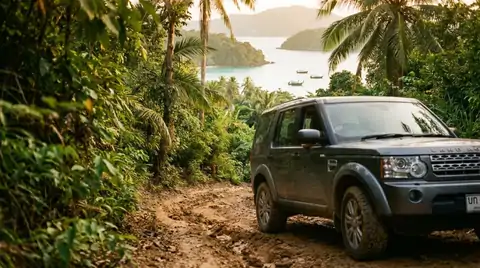
The trips it does not suit are the ones with a rough approach at the end: an unsurfaced track to a quiet bay, a construction-scarred access road, a villa on a steep concrete driveway. Those are the days when a taller car earns its place, and they are the days worth being honest about before you book.
What it means for the car
The low front overhang is what to watch. A concrete ramp up to a villa, a high crest at the entrance to a courtyard, a kerb at the edge of a parking space — those are where the scratches appear that get discussed at the end of a rental. Take ramps at an angle so one wheel rises first and the nose never meets the crest square on.
The underside is the other vulnerable area, and it is mostly about water. In the wet season the roads flood in dips and at junctions, and what looks like a shallow puddle can be a drainage channel with no lid. A small car with limited clearance is the wrong vehicle for finding out, so go around rather than through.
Everything else about the car is straightforward. The automatic gearbox is the right choice for coastal traffic, the fuel bill is small, and it holds a motorway speed on the main road north without fuss. Just keep the overtakes for flat ground when the car is full.
Who this class does not suit
A group of four adults with suitcases. The seats will manage; the boot will not, and the airport transfer turns into a session of stacking bags on laps. It is entirely foreseeable, and it is the single most common mismatch between what people book and what they need.
It also does not suit anyone whose accommodation sits at the top of a steep, broken driveway. Twice a day, every day, is a lot of exposure for a low bumper, and the damage accumulates in exactly the places that get inspected on return.
For everybody else the value proposition is simple. This is the car that makes parking a non-event, keeps the fuel spend low, and asks nothing of the driver except a little care over ramps and puddles.
TipOn a small car, do the handover video from a crouch rather than standing up. The damage that matters on this class lives low — bumper corners, the sill below the doors, the wheel rims and the rear valance — and none of it shows in a walk-around filmed at eye level.
Where to park and how
The short body opens up places bigger cars cannot use: the side streets of Kata, the lanes of the old town, the yards behind the cafés in Rawai. That is the everyday win of this class, and it is worth using deliberately rather than by accident — when you see a space, take it, because the next one may be several streets away.
Shade beats convenience most afternoons. A car standing in direct sun for a few hours becomes uncomfortable to get into, and the difference between a shaded bay and an open one is the first ten minutes of every journey.
The bans are simple and enforced. Red-and-white kerbs mean no stopping at any hour. Do not block a private gateway, even briefly, and in the rainy season keep out of the dips where water collects. None of it is complicated, and all of it is cheaper to learn from a page than from a clamp.
- Take ramps at an angle; the low overhang meets a square crest badly
- Film the front bumper and sills at handover — those are the usual dispute points
- Check the air conditioning at idle, which is when a small engine works hardest
- Count the luggage in advance; the boot takes a couple of cases, not four
- Do not overtake uphill with a full car, because the reserve simply is not there
Taking over a compact hatchback
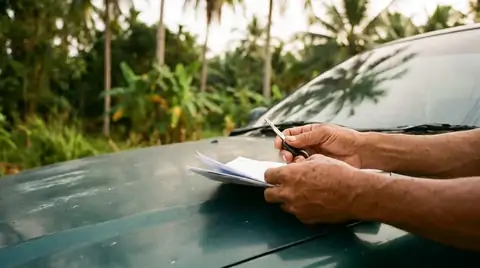
Start from the bottom: the front bumper, the sills and the rear lower edge. On a small car those are the most exposed panels and the ones that generate arguments on return. Film them together with the wheel rims, which tell you honestly how the car has been living before you got it.
Then check the things that are annoying rather than expensive: does the air conditioning cool properly while the car is stationary, do all the windows work, is there a spare wheel or a tyre kit and does the jack actually exist. A puncture on the road north is a twenty-minute event with a kit and a long afternoon without one.
Finally, agree the fuel policy and the return time in writing before you drive away, and confirm who to call if something goes wrong. That is a two-line message and it removes most of the ways a rental ends badly. Send us your dates and how many of you are travelling on WhatsApp, or Telegram if that suits you better, and we will confirm whether this class is the right size for the trip.
Cars for this trip
See all →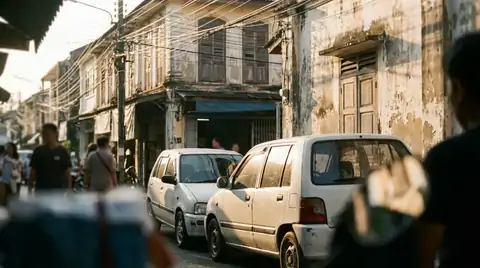
Common questions
Is the MG3 suitable for Phuket's roads?
Yes, for the driving most visitors actually do: town, beach districts and the main surfaced roads. It is the wrong tool for unsurfaced tracks and steep broken driveways, where the low nose becomes a liability.
How many people and how much luggage fit?
Two people with luggage is the comfortable case, and four fit in the seats for short island trips. The boot is the constraint, so four adults with full-size suitcases will not work for an airport transfer.
Will an MG3 make it up to a viewpoint?
It will, at its own pace, with the air conditioning running and a full car. What it will not do is overtake on the way up, so plan to sit behind slower traffic rather than pulling out on a gradient.
What gets damaged most often on this car?
The front bumper and the sills, almost always on concrete ramps rather than in traffic. Filming those areas from a crouch at handover is the cheapest insurance there is.
Is it easy to drive around the old town?
It is one of the best cars for it. The streets there are narrow with parked cars taking half the width, and a short body turns a tense drive into a routine one, particularly in the evening.
Can I take it onto a dirt road?
Better not. The clearance is urban, and the rutted tracks here have a raised crown in the middle that catches the underside of a low car, which is damage that sits outside most insurance cover.
Write to us — we will find the right car
We answer in chat: no forms, no phone calls, no waiting on hold.