The Car Rental Agreement in Phuket
There are five things worth reading in a rental agreement in Phuket: the term and the hour of return, the territory, the insurance excess, the list of damage that is never covered, and the terms of the deposit hold. Everything else in the document is standard, and almost every dispute grows out of exactly those five points.
Updated 13 September 2026
- Delivery to your hotel and the airport
- Answers in chat, no phone calls
- We go through the insurance before you sign
The five points every dispute grows from
The term is set by a time as well as a date. A car collected in the afternoon comes back in the afternoon, not whenever suits, and an overrun is counted in hours and written up as an extra day. That is the first line to look at, because it is where expectations part company.
Territory and excess
The second point is where you are allowed to drive. Some agreements limit the car to the island, and crossing the Sarasin bridge without agreeing it first puts you outside cover. If the mainland is in your plans, that conversation happens before the signature.
The third is the excess. This is the portion of any damage the renter pays when a claim is made, and it exists in nearly every agreement. Knowing its size matters far more than hearing the word insurance: cover starts beyond that line, not at the first scratch.
The fourth and fifth are what the insurance never covers and how the deposit works. Both are handled separately below, because those two are the ones that most often turn into a surprise at handover.
What the insurance usually does not cover
The standard set of exclusions looks similar everywhere: roof and underside, glass and mirrors, tyres and wheels, the interior. Added to that is damage taken off road, damage from driving through water, and damage caused by somebody who is not named in the agreement.
Why the roof and the underside
The logic is simple: that damage is hard to tie to a road event. A cracked sump after a dirt track to a waterfall, or a dent in the roof from a falling coconut, are cases the company cannot verify, so they sit outside cover. Knowing this changes a route more than any advice does, because you stop parking under palms.
Driving under the influence is its own line. It is not merely an exclusion from the insurance but an offence that collapses the whole structure of the agreement at once. If the driver had been drinking, there is no cover under any heading at all.
Read this section aloud at signing and ask one question: what happens if the damage appears in a car park with no other party involved. The answer shows how the company handles disputed cases better than any review does.
The deposit and how it comes back
A deposit comes in two forms: a hold on a card or cash against a receipt. The form matters, because it decides how quickly the money returns and how easily it can be taken. A card hold is released by the bank rather than instantly, and that is normal; cash is handed back on the spot at the inspection.
What should be written down
Look for three things in the text: the size of the deposit, the deadline for returning it, and the list of grounds on which it can be kept. Wording along the lines of held pending clarification, with no deadline attached, is a poor sign, and it is clarified before the signature rather than after.
Traffic fines are a separate story. They reach the owner of the car with a delay, sometimes after you have flown home, and the agreement usually allows them to be taken from the deposit or charged later. Ask directly how this particular company handles it and how you will be told.
Take a receipt for the returned deposit every time, even when the money came back in cash with a smile. Thirty seconds closes the subject permanently.
The condition report matters more than the contract
Attached to the agreement is a diagram of the car with the existing damage marked on it. That single sheet decides the fate of the deposit more than the whole main text, because at return it is the thing you will be compared against.
How to fill it in
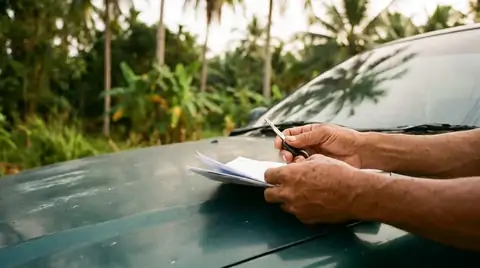
Walk round the car with the member of staff and mark everything: scratches, chips, scuffs on the bumper, the state of the wheels, cracks in the glass. Something that looks trivial now will be discussed seriously at handover. Ask for marks on the diagram rather than agreement in words.
Film it at the same time. A slow circuit of the car, each wheel separately, then the interior and the instrument panel with the readings visible. A dated video settles an argument faster than any explanation.
Check the fuel level against the document and photograph it. The fuel policy is written into the agreement, and the car goes back in the state you received it.
ImportantThe territory clause is broken more often through ignorance than intent: somebody drives to the mainland for Khao Lak or Krabi without opening the agreement. If it says the car is used within Phuket, then beyond the Sarasin bridge the insurance does not work, and anything that happens there is paid in full out of your own pocket.
What to settle before you sign
Who is named as a driver and whether a second one can be added. A car driven by somebody who is not in the papers has no cover at all, and that is the most common way to lose the whole deposit.
What to do in a breakdown: call the company or an outside workshop, who pays for recovery, and how far the recovery reaches. Ask separately whether recovery applies off the island, if taking the car there is allowed at all.
As a visitor, ask which documents the company expects to see at handover. An International Driving Permit alongside your home licence is the normal answer, and finding that out at the desk with the bags already in the boot is the wrong moment.
Extending and returning early
Ask how an extension is arranged and whether the insurance extends with it, because a gap in cover between two agreements happens more often than anyone would like. Ask as well what happens on an early return: the rules differ from company to company.
Last of all, ask for a copy of the signed agreement with every annex and photograph it. The paper original lives in the glovebox and gets crumpled, while the photograph is always with you, including the moment you are standing on a verge needing the phone number from the letterhead.
If anything in the agreement is unclear before you arrive, ask in advance rather than at the counter. Message us on WhatsApp with your dates and the class of car you want, or Telegram if you prefer, and say whether you plan to cross to the mainland.
Cars for this trip
See all →

Common questions
What is the insurance excess on a rental car in Phuket?
It is the part of the damage the renter pays before the cover starts working, and it is written into the agreement as a fixed figure. Hearing the word insurance is not enough on its own: the size of that excess is what decides your real exposure after an incident.
Can I take a rental car off the island to Krabi or Khao Lak?
Only if the territory clause allows it, and plenty of agreements limit the car to Phuket. Crossing the Sarasin bridge without agreeing it first leaves you uninsured for everything that happens on the other side.
What is never covered by the insurance?
The usual exclusions are the roof and underside, glass and mirrors, tyres and wheels, the interior, and anything that happens off road or in water. Damage caused by a driver who is not named in the agreement is excluded as well, which is why adding a second driver properly matters.
How long does the deposit take to come back?
Cash is returned at the inspection, while a card hold is released by your bank and can take several days after the car has been handed over. The agreement should name both the sum and the deadline, and wording with no deadline in it is worth questioning before you sign.
Why is the condition report so important?
Because at handover the car is compared against that diagram and nothing else, so anything unmarked is treated as new damage. Walk round the car with a member of staff, get every scuff marked on the sheet, and film a slow circuit with the date visible.
Write to us — we will find the right car
We answer in chat: no forms, no phone calls, no waiting on hold.