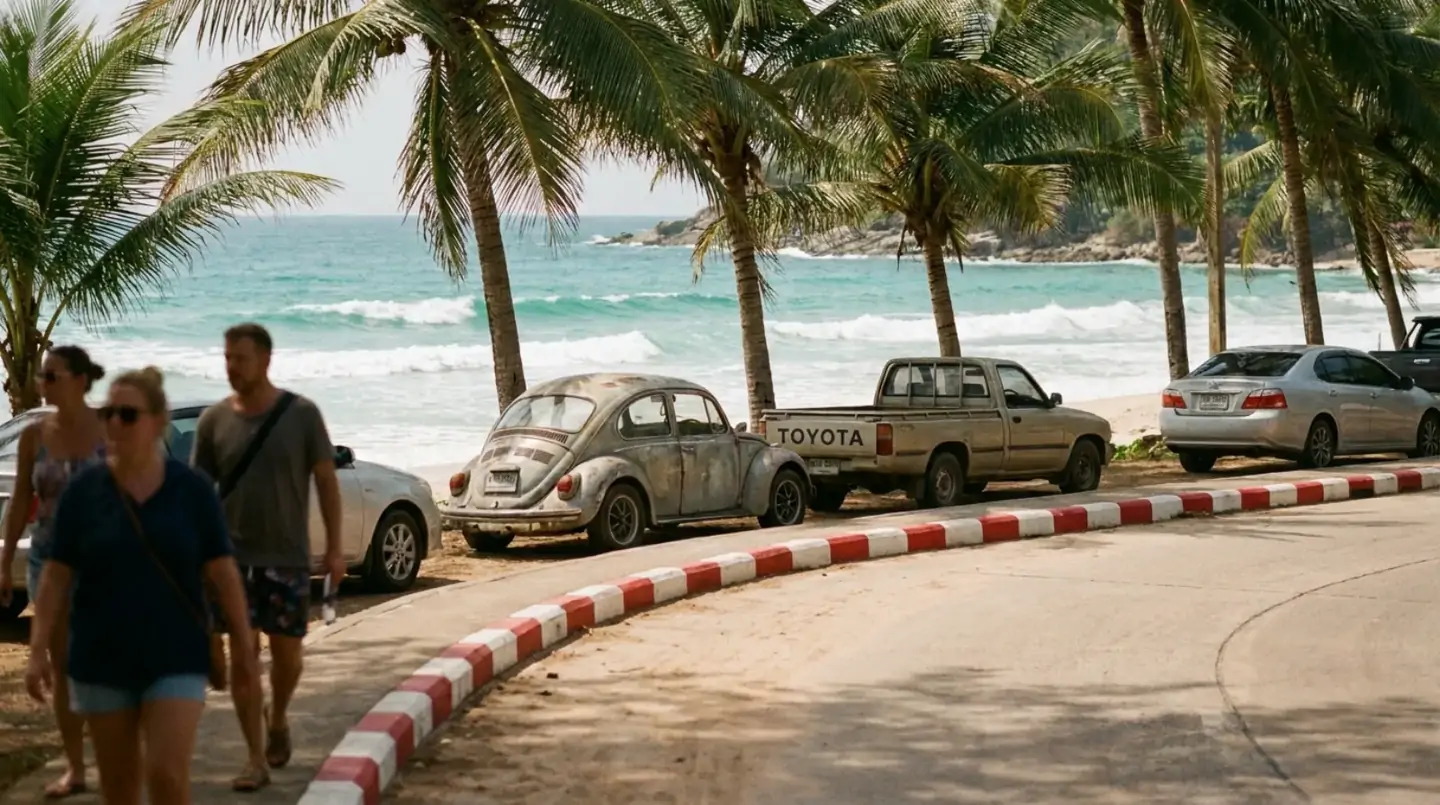
Car or Bus in Phuket
Public transport in Phuket exists and works perfectly well on the main axes: blue buses run between the airport, the town and the large beaches on a timetable. The scheme breaks down the moment you need somewhere that is not a main beach, with luggage, at a time that suits you rather than the schedule.
Updated 13 September 2026
- Delivery to your hotel and the airport
- Answers in chat, no phone calls
- We go through the insurance before you sign
What public transport really covers
The trunk routes are served properly. Airport to Phuket Town, town to Patong, town to Kata and Karon, town to Rawai: blue buses run these lines and both visitors and locals use them without drama.
For somebody travelling light, staying on a large beach and going into town now and then, that is a working arrangement. The route is easy to understand, the stops exist, and the journey takes a predictable amount of time.
Where the scheme starts to slip
The trouble appears on trips between beaches. There is no direct line from Kata to Bang Tao, for instance, so the journey is built through the town, which turns a short coastal run into a detour with a change in the middle.
The second problem is the timetable. Evening services finish before you have drunk your coffee after dinner, and the way home becomes a question the bus no longer answers.
What that means for a car
A car wins on route rather than on speed. It goes straight along the coast where the bus goes through a hub, and it reaches the places the lines never touch: waterfalls, the nature reserve, the northern beaches, the viewpoints, the markets on a weekday morning.
The price for that is parking and terrain. The island sits on hills, and the class of car is chosen for the climbs: fully loaded with the air conditioning running, a small engine works with no margin left on a long pull.
Counting time honestly
On a bus you never look for a space; in a car you do, and in high season that costs real minutes near the beaches and in the Old Town. On the other hand you never wait for a service and never bend the day around a schedule.
Evening journeys are simply easier by car. Beach roads are poorly lit, and standing on a verge in the dark waiting for something to arrive is the worst version of the evening.
How to work out which you need
Start with a map of the trips you will actually make. Write down where you are going every day and where you are going once. The daily route decides the question; the single excursion decides nothing.
Then look at three things: whether a direct line exists between your points, when the evening services stop, and how many people with bags you are moving. If even one answer is awkward, a car closes the question entirely.
Distance from your accommodation to the nearest stop matters more here than it would at home. Four hundred metres in the shade is nothing; the same four hundred metres at midday with shopping is a different judgement altogether.
The mixed approach
The most practical answer is not to choose. A bus or a scooter for short hops around your own district, and a car on the days when the plan includes distant points, a proper shop or a trip with the whole group.
Arrivals and departures work the same way: a transfer from the airport with the suitcases, and a rental picked up later, once the bags are unpacked and the routes make sense.
Family, groups and luggage
With children the arithmetic changes immediately. A pushchair, a bag of beach things, a supply of water: on a bus all of that becomes a task, and in this heat a task becomes a ruined day.
For a group the car wins on time as well. One journey replaces the coordination of timetables and changes. It shows most clearly on early runs to the piers, when the boats leave on their own schedule rather than yours.
Shopping is its own factor. A week of supplies from a market or a large supermarket without a car turns into two trips, and on that scenario the bus loses conclusively.
Child seats deserve a mention because visitors often assume they appear by themselves. They do not: a seat is something you ask the rental company for when booking, and having your own car is the only way to be certain one is fitted properly.
ImportantWaiting for transport on the verge after dark is the least comfortable scenario on the island. There is little lighting on beach roads, often no pavement at all, and scooters ride the edge of the carriageway without lights. If the evening involves coming back from somewhere distant, plan the return before you set out.
When the bus is the right answer
If you are staying in the town or on a large beach, travelling light, and your usual route sits on a trunk line, there is no reason to take a car. It will stand still while you pay attention to where it is parked.
The second case is a day or two in town for shopping and back. Public transport handles that completely, and you spend no thought on parking in the Old Town or on reversing out of a narrow one way lane.
The third is simple honesty about driving on the left. If it makes you uncomfortable, that is normal, and forcing yourself behind the wheel to save time is a poor trade. Buses, taxis and a bike with a driver cover the island without the stress.
There is also the short stay. For three or four days built around one beach and one evening in town, the paperwork, the deposit hold and the fuel policy of a rental are more administration than the trip deserves.
If the bus covers part of your week and not the rest, take the car only for those days. Write to us on WhatsApp with the dates you actually need it, or Telegram if that suits you better, and mention how many people and bags are travelling.
Cars for this trip
See all →

Common questions
Do the blue buses in Phuket run to a reliable timetable?
On the main lines they run frequently enough that waiting is rarely long during the day. The catch is the evening, when services finish earlier than most visitors expect and the last one leaves while you are still at dinner.
Can I get between two beaches without going through Phuket Town?
Usually not by bus, because the network is built as spokes from the town rather than as a coastal line. By car the same trip runs straight along the coast and takes a fraction of the time.
Is a car worth it if I am staying in Patong for a week?
If you never leave Patong and the nearest beach, probably not, since parking there is the hardest part of the island. As soon as markets, viewpoints or the northern parks enter the plan, the balance moves the other way.
What is the best option for arriving with suitcases?
A transfer straight from the airport, with the rental collected afterwards once you have unpacked. Handling luggage, an unfamiliar car and driving on the left in one go, after a flight, is more than the first hour deserves.
Write to us — we will find the right car
We answer in chat: no forms, no phone calls, no waiting on hold.