
Tuk-Tuks and Songthaews on Phuket's Roads
Tuk-tuks and songthaews are the working transport of the island, and on the road they behave according to the rules of their trade: they stop wherever a hand goes up, and they pull out of a side road expecting you to ease off. Knowing that manner removes most of the surprises of a first day behind the wheel.
Updated 13 September 2026
- Delivery to your hotel and the airport
- Answers in chat, no phone calls
- We go through the insurance before you sign
What these vehicles are and where they run
A songthaew is an open truck with benches along the sides, the local public transport. The routes link Phuket Town with the beaches and markets, they run in daylight and fade out in the evening. People get on and off while it is moving, quite literally: the driver slows and the passenger steps down.
Tuk-tuks in Phuket are not the three wheelers of Bangkok: here they are small brightly painted vans that wait at ranks by the beaches and work to their own rules. Their territory is the resort districts, short journeys and evening runs.
Why there are so many on narrow streets
Because that is where their customers are. In Patong, Kata and Karon these vehicles hold ranks at the beach entrances and by the markets, and all the movement around those points is built around them. Passing one, it is sensible to assume it can pull away without warning.
One more thing that catches newcomers out: both often drive with the tailgate open and people sitting right at the edge. Overtaking closely is not an option even with an empty oncoming lane, because somebody on that bench is half a metre from your mirror.
What it means for your car
First, distance. A songthaew brakes sharply and without signalling, because a passenger has waved from the verge. If you are close behind, you have no margin at all, and there is probably a scooter pressing you from behind as well.
Second, overtaking. On a two lane road it is dangerous to overtake a songthaew where you cannot see the whole oncoming lane: the island is hilly, and a gentle crest often hides a bend. Local drivers overtake boldly, and there is no need to copy them.
Third, blind spots. The high sides of the truck hide the pedestrian crossing in front of it and the scooter coming along the far verge. Pulling out blind from behind one is the most common cause of minor collisions in the resort districts.
At night
Not all the lights work on older vehicles, and in the dark you see one red point rather than an outline. At night the gap has to be larger still and the speed lower.
Driving a narrow resort street
A Patong street in the evening is a mixture of cars, scooters, tuk-tuks and pedestrians walking in the carriageway because the pavement is full of stalls. There is only one correct way to behave in it: slowly and predictably.
Signal every move and make it early, then hold your line. Sudden corrections are what other people cannot read, and everybody around you is reading you constantly.
Let people out rather than defending your half metre. Nothing on this island is far enough away for that half metre to matter, and the mood on a crowded street stays much better for it.
When somebody flashes their lights
A short flash of headlights in Thailand usually means I am coming through rather than after you. The convention is local and unfamiliar, and it is exactly what newcomers get wrong at their first junction.
The horn works the same way. Here it is short and informational, announcing your presence on a blind bend, and a long blast reads as aggression and achieves nothing.
ImportantA collision with local commercial transport always takes longer and is more complicated to settle. Do not move the vehicles before the police and the insurance representative arrive: a position altered after the fact is not interpreted in your favour.
Ranks and parking near them
At the beach entrances and near markets there are marked working areas for these vehicles. They look like ordinary parking, especially on a quiet morning, but standing there brings you both a complaint and a blocked exit.
The giveaway is a row of identical vehicles and a canopy with a bench where the drivers sit. If that row is there, the empty spaces in it are still their territory.
Ordinary spaces for visitors do exist at the beaches, usually slightly away from the entrance along the side streets. Walking a hundred metres is a fair price for a calm return to your car.
The kerb markings apply here too. Red and white means no parking, red and yellow means dropping off only, and near the working areas those colours appear more often than they do in residential blocks. Removal trucks reach the popular beaches quickly.
When the local transport helps you
Having a rental car does not cancel the local transport. On a day when you want to wander the town and drink coffee in the old quarter, leaving the car at the hotel and taking a songthaew in is a sound idea: no hunting for parking in the centre and no thinking about kerb colours.
It works for coming back from a bar as well. In the evening you leave the car at the hotel car park and travel in on somebody else's transport, then collect it in the morning without a conversation with the police. Cheap insurance against the most expensive mistake available.
It also helps when the car has gone in for a service for the day. The route into town runs regularly and costs very little compared with a taxi.
There is almost no direct connection between neighbouring beaches: nearly everything runs through the town. That is precisely why people rent a car here, not to save money but to stop building the day around somebody else's route.
If you want a car for the days that need one and nothing on the rest, that is easy to arrange. Message us on WhatsApp with the dates you actually need, or Telegram if you prefer, and mention which district you are staying in.
Cars for this trip
See all →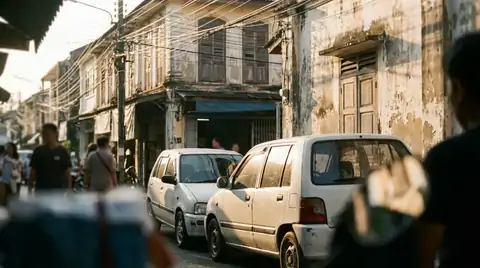

Common questions
What is the difference between a tuk-tuk and a songthaew in Phuket?
A songthaew is a small truck with benches that runs a fixed route between the town and the beaches, functioning as public transport. A tuk-tuk here is a small bright van that waits at ranks and works as a taxi within the resort districts.
Why do these vehicles stop in the middle of the lane?
Because they stop wherever a passenger waves, and an indicator is not part of the routine. The only defence is distance: keep more space behind them than feels necessary, particularly on the resort streets.
Is it safe to overtake a songthaew?
Only where you can see the entire oncoming lane, which on a hilly island is less often than it looks. People also sit at the open edge of the tray, so passing close is dangerous even with a clear road ahead.
Can I park in one of their ranks if it looks empty?
No, those marked areas belong to the drivers who work from them, and parking there earns you a complaint and a blocked exit. Use the ordinary spaces on the side streets a little away from the beach entrance.
What should I do after a collision with local transport?
Leave the vehicles exactly where they stopped and wait for the police and the insurance representative. Moving them first, even to clear the road, makes the reconstruction harder to argue in your favour.
Write to us — we will find the right car
We answer in chat: no forms, no phone calls, no waiting on hold.