
Scooter Rental in Surin, Phuket
Surin is a small district where almost everything stands on a hillside: the road from the main route down to the beach descends, and getting back means climbing narrow streets with steep sections in them. A bike is convenient here because the place is compact, but it asks for confident brake work on those short gradients.
Updated 13 September 2026
- Delivery to your hotel and the airport
- Answers in chat, no phone calls
- We go through the insurance before you sign
A district on a hillside
The logic of Surin is simple: the main road above, the sea below, and a net of short streets down the slope between them. The descent to the beach takes a minute and the climb back much the same, and it is on these short gradients that the small mishaps happen: stalling on a climb, rolling back, losing the bike on wet concrete.
The access lanes to housing
Many houses and villas sit on side lanes one car wide. A bike passes freely there, and that is its main advantage over a car. An oncoming car in such a lane means somebody has to reverse, and on two wheels it is simpler to be the one who gives way.
Lighting on the side streets is poor, and the surface in places is concrete with transverse grooves cut into it. After rain those sections are noticeably more slippery than asphalt, and you climb them on a steady throttle without any sudden inputs.
Distances in Surin are short, so the bike spends more time parked than moving: ride to the beach, leave it, come back. The practical conclusion is that lightness matters more than power, because turning a heavy machine round in a narrow steep lane is awkward.
Brakes and hill starts
A short steep climb is a specific problem on two wheels. Pulling away uphill has to be smooth, because a sharp throttle breaks traction at the rear wheel, especially on wet concrete. Hold the rear brake until the engine is already pulling and then release it gradually.
Going down to the sea
Coming down, let the engine hold you and brake gently with both brakes. The temptation to coast down in neutral ends with running out of brake at the bottom of the descent, which is where cars are usually parked.
With a passenger all of this becomes twice as demanding. If you are riding two up without much experience, it is safer to drop your passenger before the steepest section and pick them up at the top, which looks comical right up until the first fall.
Dogs on the side streets are a normal part of the district. They lie on the warm surface and do not always move out of the way. Do not sound the horn right beside them and do not swing onto the other side of the road on a blind bend; slow down and go round in a wide arc instead.
ImportantWet grooved concrete on a climb is the most common place to fall in districts like this. The rear wheel lets go with almost no warning. In rain those sections are better walked, pushing the bike alongside, than attempted on the throttle.
Getting out of the district
South to Kamala and north to Bang Tao runs the coast road over the hills: scenic, but with changes of gradient and blind corners. To the east you can join road 4025 and then 4030, where the traffic already moves at speed.
Which one to choose
For short trips to the neighbouring beaches the coast road is both easier and more pleasant. For longer routes take the main road, but on a bike hold the left lane and do not try to keep pace with the cars.
In the rainy season the coastal stretch collects water and debris washed off the slopes. Take it slowly after a heavy squall, because under the water at the edge there is sometimes a washed out hole you cannot see.
The morning and evening hours at the junction with the main road are busier than the rest, since this is a residential area and people leave and return at roughly the same times. A couple of minutes in hand removes the temptation to squeeze into a short gap in the traffic.
- Coast road for the neighbouring beaches
- Main road for anything longer, holding the left lane
- Slowly over the coastal stretch after heavy rain
- Extra minutes at the junction in rush hour
Helmet, licence, parking
The requirements are the general ones: a fastened helmet for rider and passenger, a national licence with category A open, and an International Driving Permit carrying the same category. Checks in this district happen at the junction with the main road rather than down by the beach.
Where to leave the bike
There are few spaces at the beach entrance, and this is where a bike wins: it fits where a car no longer does. Parking along the streets on the slope is fine, but make sure you are not blocking a narrow lane, because their width barely accommodates one car.
On a gradient always turn the wheel to the kerb and check the stand is on something firm. Soft earth after rain gives way, and the bike lies down on its side without any help from anyone.
The district is dark in the evening: there are few street lights on the side roads and the greenery hides the ones there are. Coming back after sunset, slow down in the lanes, because people walk on the carriageway here for the simple reason that most streets have no pavement.
Renting a scooter in Surin
The district works well for everyday riding provided the gradients do not bother you. Anyone sitting on two wheels for the first time is better off starting on the flat roads of neighbouring Bang Tao and coming back here a couple of days later.
What to check
Brakes, the grip of the rear tyre, and the headlight. All three are tied directly to the terrain of this district rather than being general advice you could apply anywhere.
Film the bike at the handover and confirm what to do about a puncture or a breakdown. There are not many workshops nearby, and having the number in advance is more useful than looking for one on the verge.
Ask separately what engine size you are being given. On constant short climbs a weak motor with a passenger works hard, and the difference between the smallest option and a slightly larger one is felt here every single day. Write to us on WhatsApp with your dates and where you are staying, or Telegram if you prefer.
TipSurin combines well: a bike for the district and the neighbouring beaches, a car for trips into town and to the airport. The narrow lanes on the slope were not built for a car, and in everyday life two wheels really are faster here.
Cars for this trip
See all →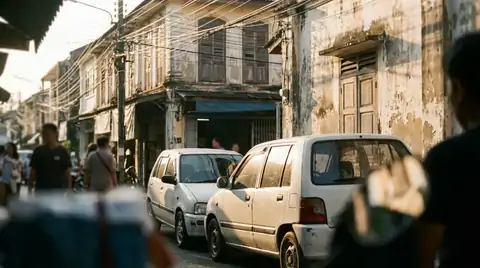
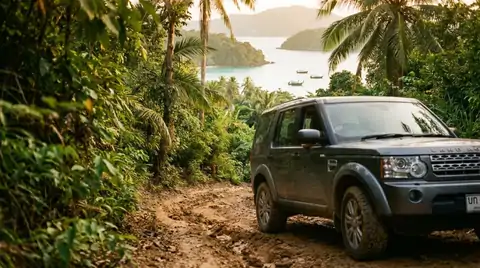
Common questions
Is it difficult to ride a scooter in Surin?
The district sits on a slope, so every journey includes short steep gradients. A confident rider finds that straightforward, while a beginner should practise first on the flat roads of the neighbouring district.
How do I pull away uphill on a scooter?
Smoothly, holding the rear brake until the engine starts to pull, then releasing it gradually. A sharp throttle on wet concrete breaks traction at the rear wheel before you have moved anywhere.
Why is grooved concrete a problem?
After rain it is more slippery than asphalt and the wheel loses grip with almost no warning. Those climbs are safer walked in the wet, pushing the bike beside you, than ridden on the throttle.
Where do I park near Surin beach?
There are few spaces at the entrance to the sand, but a bike fits where a car no longer does. The one thing to watch is not blocking the narrow lanes that lead to people's houses.
Which documents do I need to rent a bike?
A national licence with category A open, an International Driving Permit with the same category, and your passport. Helmets are compulsory for the rider and the passenger alike.
Should I take a bigger engine for this district?
If you ride two up regularly, yes, because the short climbs come constantly and a weak motor labours on them. Riding alone within the district the smallest machines cope perfectly well.
Write to us — we will find the right car
We answer in chat: no forms, no phone calls, no waiting on hold.