Scooter Rental in Phuket Town
Phuket Town is the only real city on the island, and a scooter works here as city transport: one way streets through the old quarter, dense traffic on the roundabouts and a permanent shortage of space for a car. The ground is flat, and in exchange there are more rules and more junctions than anywhere else on Phuket.
Updated 13 September 2026
- Delivery to your hotel and the airport
- Answers in chat, no phone calls
- We go through the insurance before you sign
Riding in a city on a holiday island
Unlike the beach districts, everything here behaves like a town: traffic lights, road markings, lanes, pedestrian crossings. There is also a rhythm to the day. People ride to work in the morning, the traffic thins in the middle of the day, and in the evening the old quarter fills with people out walking.
One way streets
The old quarter is laid out as a grid in which many streets run one way. Turning into the wrong one is easy, and riding against the flow on a bike is a quick way to meet both the police and an oncoming pickup. Read the markings, and read the parked cars: the direction they face tells you which way the traffic goes.
Speeds in town are low, and that changes the shape of the risk. What hurts you here is not velocity but surprise: a door opening on a parked car, a U turn across two lanes, a pedestrian appearing between rows.
The surface in the old quarter is uneven in places, with covers, joints and patched repairs. On a bike that is felt more than in a car, and in rain the metal manhole covers become genuinely slippery, so you neither brake nor turn on them.
The roundabouts
The circles are the town's main nodes and almost every route passes through them. Traffic inside runs clockwise and anyone joining gives way to those already on the roundabout. For riders used to driving on the right, that direction feels unnatural for the first day or two.
How to take a roundabout on two wheels
Hold the outer line, signal in advance and do not change your line inside the circle. Cars change lanes constantly there, and a bike running the inner radius sits in almost everybody's blind spot at once.
If you miss your exit, do not cut across to reach it. Go round again; it costs twenty seconds and removes the whole risk in one move.
A useful habit is knowing your exit before you arrive. In town the roundabouts come one after another, and a rider deciding the route while inside one brakes and hesitates, which on two wheels is the most dangerous thing you can do, precisely because nobody behind is expecting it.
ImportantThe most common city accident involving a bike is contact with a car that is turning or changing lanes without having seen you. Stay out of blind spots, do not ride alongside the flank of a car for any length of time, and do not try to pass between two moving rows.
Parking in town
Here the bike beats the car openly: in the old quarter a car struggles to find a space, while two wheels have designated zones at almost every significant place, at the markets, the malls and along parts of the streets.
What the kerb colours mean
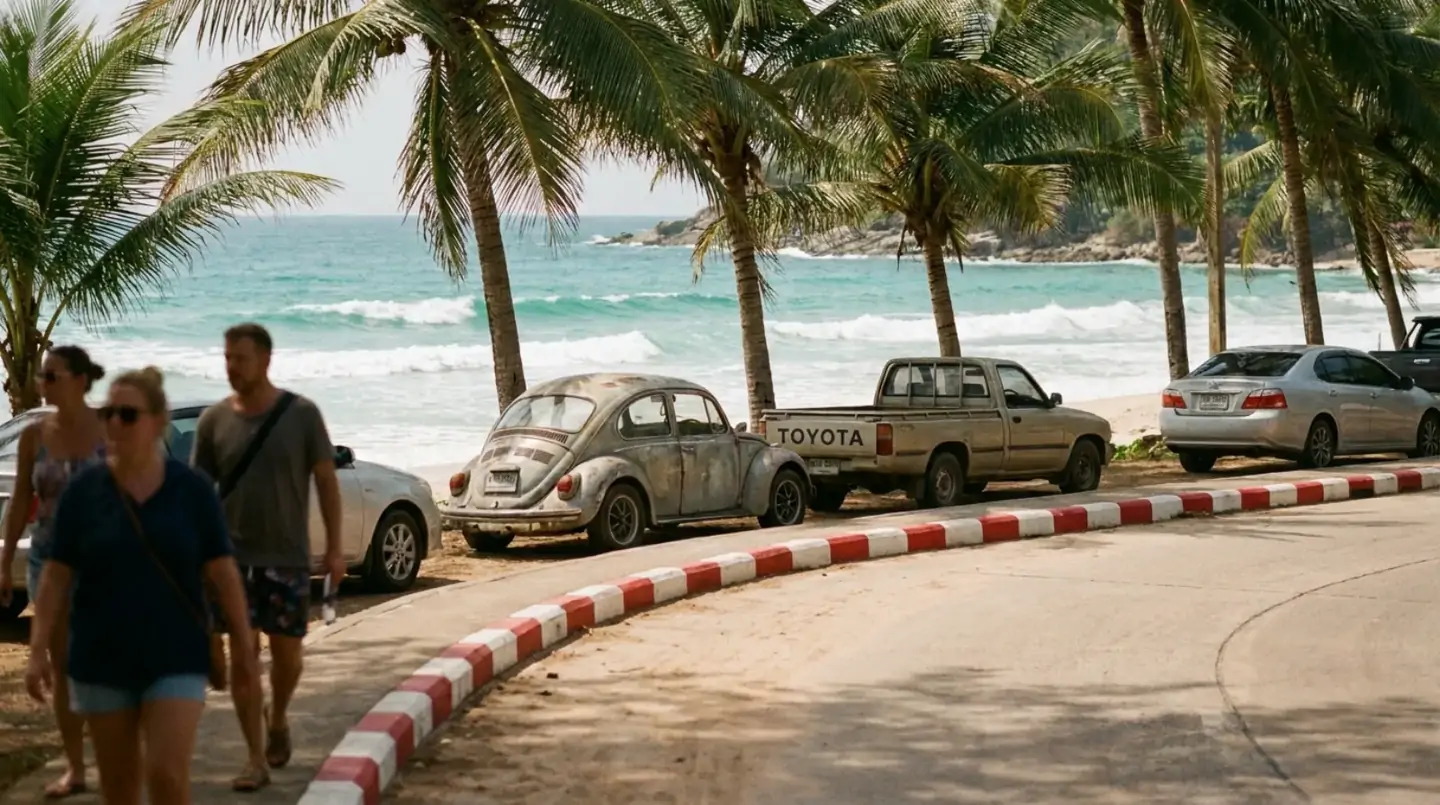
A red and white band means no parking, and it means it for bikes too. In town that is watched more closely than on the coast, because a blocked lane on a narrow street creates a jam within moments.
Under the arcades of the old quarter people are walking, and a bike left across the passage produces questions from the shop owners faster than from the police. Use the marked rows, of which there are enough.
On days when the town holds an event, and during the weekend evenings, those marked rows fill completely. The same rule then applies as with a car: park to one side and walk a couple of blocks rather than hunting for a space by the door.
- Marked two-wheeler rows at markets and malls
- Red and white kerb applies to bikes as well
- Never across a passage under the arcades
- Park two blocks out on event evenings
Documents and checks
Posts are seen more often in town than in the beach districts, since junctions and the exits onto the trunk roads are controlled regularly. The requirements are the usual ones: a fastened helmet for rider and passenger, a national licence with category A and an International Driving Permit carrying the same category.
How a check plays out
Calmly and quickly, when the documents are in order. A missing category or a missing helmet ends in a fine on the spot, and sometimes in the bike being held until things are clarified. The same gap also removes your insurance cover in any incident.
Keep the documents on you rather than at your accommodation. Carrying them in a waterproof sleeve is practical all year, because in the wet season a pocket soaks through in a single squall.
The town also has a higher density of cameras and more attention to details such as whether your indicator is on. That is no reason to be nervous: ordinary road discipline works here exactly as it does in any city, and a check with correct papers takes a minute.
Renting a scooter in town
Phuket Town is a working district, and bikes here are taken for a long time, a month and upwards. Short distances, small fuel consumption and free parking almost everywhere make two wheels the most practical way to run an ordinary week.
What to check
Brakes, headlight, indicators and horn. In town the indicators and the horn are in constant use, unlike on the empty beach roads, and an indicator that does not work creates a real risk rather than a theoretical one.
Film the bike at the handover, confirm the insurance terms and agree what happens after minor contact. In dense city traffic scratched plastic is by far the most common outcome, and that conversation goes better before it happens than after.
Tell us how long you need the machine for, since a month of city riding and a week of it are different jobs for the same bike. Message us on WhatsApp with your dates, or Telegram if you prefer, and say which part of town you are based in.
TipIf you want to walk around the old town, ride in and leave the bike in a marked row outside the quarter itself. The streets under the arcades were built for people on foot, and in the evening moving through them on any vehicle is pointless.
Cars for this trip
See all →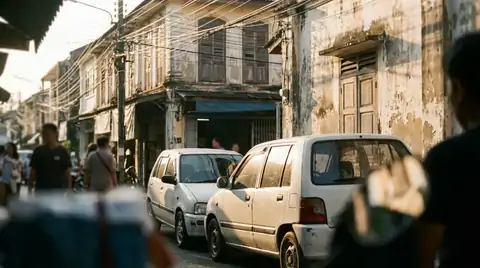

Common questions
Is a scooter convenient in Phuket Town?
Yes, it is the most practical transport for the town. Distances are short and two-wheeler parking exists almost everywhere, while a car has a visibly harder time finding a space in the old quarter.
How do I take the roundabouts?
Traffic circulates clockwise and anyone joining gives way to those already inside. On a bike it is safer to hold the outer line and not to change your line while you are on the roundabout.
How do I tell whether a street is one way?
By the markings, and by the direction the parked cars are facing, which shows you which way the traffic runs. There are many one way streets in the old quarter, so it is worth checking before you turn in.
Are documents checked often in town?
More often than in the beach districts, with posts at junctions and on the exits to the trunk roads. You need a helmet, a national licence with category A and an International Driving Permit.
Where do I park in the old quarter?
In the marked rows at the markets, the malls and along parts of the streets. The red and white kerb marking applies to bikes too, and the arcades are for people walking rather than for parking.
Is it worth renting a scooter for a whole month here?
For anyone living in town it usually is, because distances are short and parking costs nothing in most places. Longer rentals are also where it makes sense to insist on a machine in good condition rather than the cheapest one available.
Write to us — we will find the right car
We answer in chat: no forms, no phone calls, no waiting on hold.