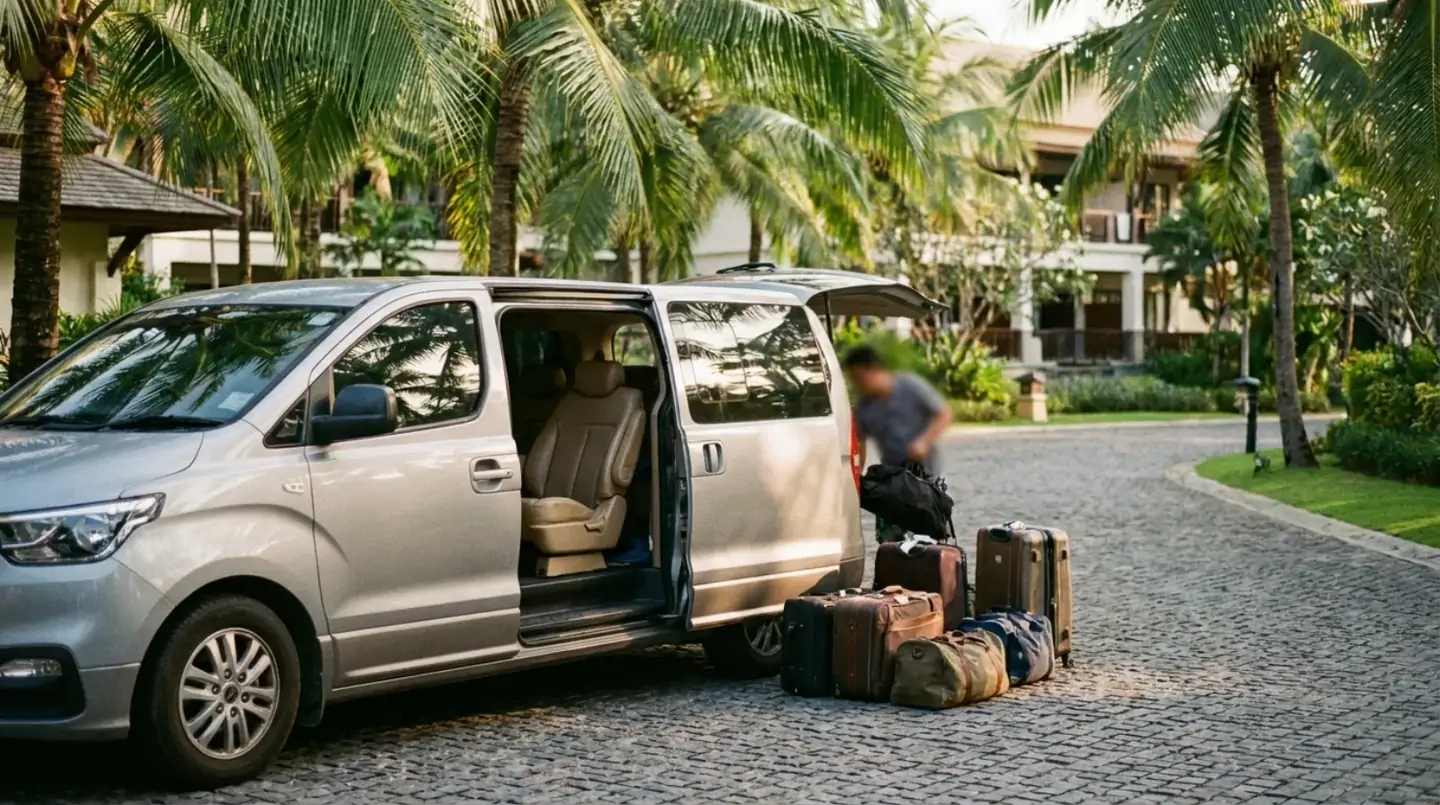
Phuket to Ko Lanta by Car
The drive from Phuket to Ko Lanta is around 250 kilometres and about four and a half hours of driving: the Sarasin bridge, road 402 to the Khok Kloi interchange, highway 4 through Phang Nga and Ao Luek to Krabi, then road 4206 to the Ban Hua Hin pier and a short ferry. The arithmetic breaks in one place, which is when you reach the pier and meet the queue of cars waiting to cross.
Updated 13 September 2026
- Delivery to your hotel and the airport
- Answers in chat, no phone calls
- We go through the insurance before you sign
The route step by step
There is one way off the island, the Sarasin bridge in the north. Beyond it road 402 leads to the interchange at Khok Kloi, and there the route turns east onto highway 4, signed as Phetkasem. From there the road runs through the town of Phang Nga and Ao Luek to Krabi, and that is the longest, flattest and dullest part of the drive.
From Krabi highway 4 continues south. Road 4206 branches off it, short and narrow with villages along the verges, and it ends at the Ban Hua Hin pier. The ferry from there goes to Ko Lanta Noi, which is not yet the island you came for.
Ban Hua Hin is not the resort near Bangkok
This is where people lose half a day. Ask a navigation app for Hua Hin and it offers the resort town in Prachuap Khiri Khan province first, which stands on the other coast of the country nine hours to the north. The point you want is the village of Ban Hua Hin in Krabi province, and it is entered as a pier rather than as a settlement. Check the first arrow on the screen: if it points north, the route has been built to the wrong place.
From Ko Lanta Noi the Siri Lanta bridge carries you to the main island. There is no second ferry and the bridge crossing takes a minute. The first village on Ko Lanta Yai is Saladan, which is both the northern entrance and the place where the shops, cash machines and fuel stations are concentrated.
- Sarasin bridge, road 402, Khok Kloi interchange
- Highway 4 through Phang Nga and Ao Luek to Krabi
- Road 4206 to the Ban Hua Hin pier
- Ferry to Ko Lanta Noi, then the Siri Lanta bridge
What that means for the car
The road to the pier is surfaced all the way, and on the mainland part the class of car barely matters: an economy car covers those four and a half hours as calmly as a crossover. The difference starts after the Siri Lanta bridge, where the surface stops being even.
Air conditioning is tested in the queue, not on the highway
The queue at the pier stands in the open. There is no shade, the car is not moving and there is no airflow through the radiator from your own speed. On the highway almost any air conditioning cools; in a stationary car under the sun, not any. Notice weak cooling before you set off rather than on the crossing.
Pack compactly for this route. Lanta has one main road with passing places on the narrow sections, and a car loaded to the roof with no view out of the back makes those passes considerably more nervous than they need to be. Bags low, nothing on the parcel shelf.
The ferry and driving onto it
The crossing is short, the boats run frequently and they leave when they are full, so there is nothing to book and nowhere to book it. You simply arrive, join the tail of the queue on the approach to the pier and wait for your batch of cars.
There is one common queue for everyone: cars, pickups, motorcycles. Staff on the pier keep the order and show you when to drive on and where to stand on the deck. Arguing with their gestures is pointless, because the layout on the ferry is tight and worked out in advance.
What you do on the deck
You board up a ramp, on a gradient with a small step at the join. Walking pace on the way on, wheel straight, no corrections. Stop on the spot indicated, select neutral or park, pull the handbrake fully on, switch the engine off. Then get out: there is no reason to sit inside on a short crossing, and the open deck is cooler.
Leaving repeats the same in reverse. Start the engine once the ramp is already down and drive off in turn without trying to get past your neighbour, because on a narrow ramp that ends as a scrape along somebody else's wing.
ImportantA handbrake that is not fully on is the commonest cause of damage during the crossing. On the slope of the ramp, or in any movement of the boat, the car sets off by itself and rests against the one in front, and sorting out that contact costs you half a day and, if the insurance is disputed, the deposit as well.
Roads on the island itself
Ko Lanta Yai has one main road and it runs along the west coast from north to south. It is narrow. Most of it has no markings, the verges are soft, and oncoming bikes regularly appear from behind a bend riding down the middle of the lane.
The north and the middle of the island are easy going: tolerable surface, gentle gradients, modest speeds anyway. The further south you go towards the national park, the more often you meet short steep climbs, with the asphalt on them giving way to broken sections with potholes and washed out gravel.
Where a crossover earns its keep
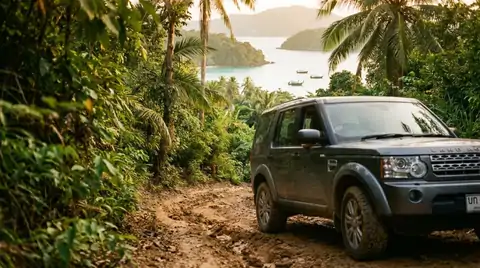
In the southern part specifically. The climbs there are short but abrupt, a low car catches its underside on the uneven surface, and on a wet gradient the front wheels spin if you try to pull away halfway up. If your accommodation is in the south of the island, the class of car stops being a matter of taste.
After rain a climb like that is taken with momentum and without changing gear, in one movement. Do not stop in the middle: pulling away again on wet gravel is harder than driving the whole gradient in one go.
TipFill up on Lanta at Saladan while the tank is still above half. Further south the pumps are sparse and keep their own hours, and a round trip for fuel eats more time than the drive to the park does.
Where to park on Lanta
Parking on the island is simpler than on Phuket and you notice that straight away. Most guesthouses and beach kitchens have their own yard or an area under the trees, there is enough room, and there is no security because none is needed.
The one tight spot is Saladan. The village sits on the pier, it has a single street, and when the passenger boats arrive cars stand along it two deep and block the way through. It makes more sense to leave the car slightly away from the central street and walk a couple of hundred metres.
Fines are rare on the island, but the kerb rule is the same as on Phuket: a red and white band means no parking. A blocked exit from somebody's yard is resolved here by conversation rather than by a ticket, and that conversation will take your evening.
If you want the car ready for a Lanta trip with the ferry in the plan, tell us in advance. Write on WhatsApp with your dates and where you are staying on the island, or Telegram if you prefer, and confirm that mainland travel is included.
Cars for this trip
See all →
Common questions
How long is the drive from Phuket to Ko Lanta?
Around 250 kilometres and about four and a half hours of driving to the pier. The ferry wait is not included in that, and it is what makes the total time vary.
How many ferries are there to Ko Lanta?
There is one ferry, from the Ban Hua Hin pier to Ko Lanta Noi. From there the Siri Lanta bridge leads to the main island of Ko Lanta Yai, so there is no second crossing.
Do I need to book the ferry in advance?
No booking is needed, because the crossing is short and the boats run often and leave when full. You join the queue on the approach to the pier and wait for your batch of cars.
Which car do I need for Ko Lanta?
The road to the pier is surfaced and any class handles it. The south of the island decides the answer, because the short steep climbs and broken surface there suit a crossover better than a low car.
What is the confusion about Hua Hin?
The pier is called Ban Hua Hin and sits in Krabi province, while the well known resort of Hua Hin is in a completely different part of the country north of Bangkok. A short search term sends the navigation to the resort, so enter the point as a pier.
Can I use a bike on Lanta instead of a car?
You can, though with luggage and on the southern climbs a bike is at a disadvantage, since the surface there is broken and the gradients abrupt. For two people travelling light it works; for a family it does not.
Write to us — we will find the right car
We answer in chat: no forms, no phone calls, no waiting on hold.