Nature Parks of Phuket by Car
The wild part of the island begins where the resort strip ends: the Khao Phra Thaeo reserve in the centre, the mangrove forests in the east and the forest roads in the hills of Thalang. Any car can go there, but almost everywhere the last kilometres leave the asphalt, and after rain those kilometres decide whether you arrive or turn back.
Updated 13 September 2026
- Delivery to your hotel and the airport
- Answers in chat, no phone calls
- We go through the insurance before you sign
Three natural directions and the roads to them
The first is the centre of the island, the reserve with its waterfalls and forest paths. The approach comes off Thepkrasattri, the turning is signed, and the road to the gate is surfaced and calm. The second is the east, the mangrove dykes and the viewing boardwalks beyond the piers, reached by a narrow road along the water where passing a lorry is not possible everywhere. The third is the hills of Thalang and the west, where forest roads run out to points overlooking the bay.
The distances are short and the travel time is deceptive. Twenty kilometres on inland roads takes longer than forty on the main road: constant bends, scooters, dogs on the verge and a fruit lorry in no hurry at all.
Where the navigation stops working
The map takes you to the park gates accurately. Beyond that, to a path, a waterfall or the mangrove boardwalks, unnamed tracks begin, and the navigation draws a line where a barrier stands. From there you navigate by the park's own signs, which do exist, simply faded.
What that means for the car
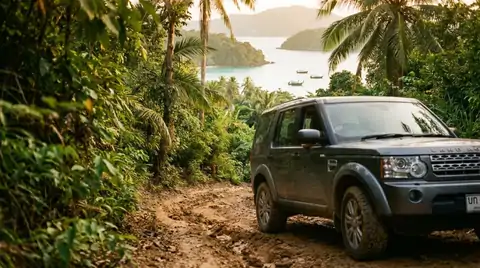
A crossover justifies itself here through clearance and seating height rather than through four wheel drive. On a rutted track a low bumper collects stones, and after a downpour there is water in the rut whose depth you cannot see. Four wheel drive is almost never needed on Phuket; spare ground clearance is.
Tyres. Rental cars live on asphalt, and on wet clay their rubber behaves like skis. On a climb you feel it immediately: the wheels break away and the car crabs sideways. Turning round at that moment is worse than calmly reversing back down your own ruts.
Fuel and signal. The stations stand on the main roads and there are none inside the forest zone, while the signal disappears for whole stretches in the valleys. You drive into the forest with a full tank and a downloaded map, which is ordinary local habit rather than excessive caution.
Washing afterwards
Red laterite dust works into the sills and wheel arches, and the car has to come back in the condition you took it. A wash on the way home costs less than an argument in the rental's yard.
Where to park at the natural sites
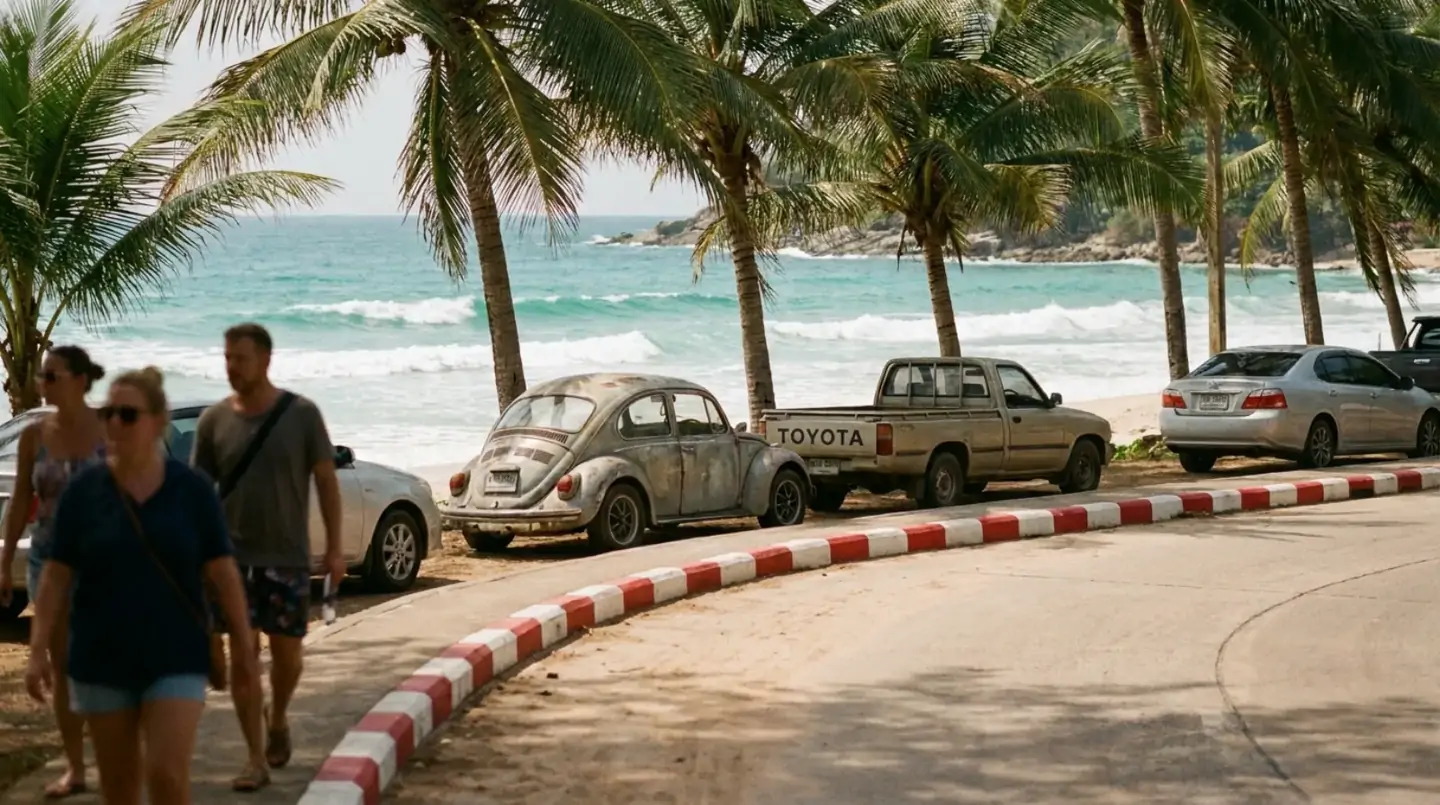
There is a proper area with shade at the reserve gate. At the waterfalls and the paths there is a widening in the road where cars stand two deep, and being first out of it is not an option. At the mangrove boardwalks there is no parking at all: the dyke is narrow and stopping on it blocks the road.
Shade is chosen for more than comfort. A car that has stood for three hours in the sun greets you with a scorching steering wheel, and the air conditioning only reaches its stride a couple of kilometres later.
Monkeys. On the approaches to the forest sites they work methodically: an open window, a bag on a seat, a bottle forgotten on the dashboard. Closed windows and an empty cabin are the only way to avoid dealing with scratched trim afterwards.
ImportantLeaving the asphalt in rain is a frequent cause of an insurance argument, because damage to the underside and bumper on an unsurfaced road is simply excluded from many rental agreements. If the rut is deeper than your hand, walking from there is cheaper than driving.
Mangroves and the dyke roads of the east
The east coast looks empty on the map and that is an honest picture: there are no beaches here, but there are boat piers, mangrove forests and narrow roads on dykes between the water and the trees. The surface is decent, and the width is such that an oncoming pickup pushes you right to the edge.
The tide changes the picture. At low water the mangroves stand on mud; at high water the road in places sits level with the surface, and on the low sections there can be flooding after heavy rain. You cannot judge the depth of a puddle on a dyke, because there is no edge to it, only a slide into the silt.
The viewing boardwalks lead out into the thickets and cars are left right on the verge beside them. The rule is simple: all four wheels have to be on something firm. Wet grass at the edge of a dyke behaves like soap under the weight of a car.
Building a day around the nature sites
A working combination is the reserve in the morning, lunch in Thalang, mangroves and sunset in the east. The transfer between the centre and the east coast takes about half an hour and is the only long leg of the day.
The second option, for anyone staying in the west, is the hills and the viewpoints in the morning, down to the water at lunchtime and back before dark. A night drive on forest hill roads without lighting is a trial of its own and a beginner is better off skipping it.
The jungle is walkable without a guide as long as you keep to the park's marked paths. Beyond them the real forest begins, where the phone has no signal and the tracks disappear into the undergrowth within a hundred metres.
If the forest tracks are part of your plan, ask for a car with clearance when booking. Message us on WhatsApp with your dates, or Telegram if you prefer.
Cars for this trip
See all →
Common questions
How do I drive to Khao Phra Thaeo?
The reserve sits in the centre of the island and the approach runs off the Thepkrasattri road at a signed turning. The road to the gate is surfaced and the drive from the resort strip takes about half an hour, while the tracks to the far paths beyond the gate are unsurfaced.
Do I need a four wheel drive for the nature parks?
Four wheel drive is not needed and very few people on the island take one. Clearance is what counts, because the last kilometres to the waterfalls and viewpoints run on rutted earth where a low car catches its underside.
Where are the mangroves and can I drive to them?
They stretch along the east coast, reached by narrow dyke roads beyond the piers. You can drive right up to the viewing boardwalks, but there is no parking there and cars stand on the verge, only where all four wheels are on firm ground.
Can I walk in the jungle on my own?
Yes, the marked paths of the reserve are walkable without a guide, entering through the park gate. Beyond the paths the forest gives no signal and no landmarks, so leaving the route is unwise even for a short wander.
When is the best time to visit the waterfalls?
In the morning, because the forest is close and humid by day and the earth sections soften after an afternoon downpour. Towards evening mist rises on the hill roads and the drive back through the forest in the dark becomes a long one.
Does the car need washing after a forest trip?
Usually yes, because red laterite dust works into the sills and wheel arches and shows clearly. A wash on the way home costs less than a discussion about the condition of the car at the return.
Write to us — we will find the right car
We answer in chat: no forms, no phone calls, no waiting on hold.