Phuket Theme Parks by Car
The large parks of the island stand away from the resort strip, along the inland roads of Thepkrasattri and Chalermprakiat, and they are all reached the same way: out of your district onto the main road, ten to twenty minutes straight, then a turning to the right. The scheme breaks in two cases, the evening peak on the way out of Kathu and rain, after which the earth part of a car park turns to porridge.
Updated 13 September 2026
- Delivery to your hotel and the airport
- Answers in chat, no phone calls
- We go through the insurance before you sign
How the approaches work
The island's entertainment sites are spread across three directions. The water parks and large themed venues are north and central, closer to Thalang and Kathu; the activity park with rope courses lies beyond Kathu towards the hills; the marine show venues are in the east, near the road to the bridge. All three directions converge on two main roads, and if you are staying on the west coast the first kilometres are always the same: a climb over the pass and a descent into the inland valley.
The navigation guides you to the gates rather than to the car park entrance. On Phuket those are different points: the pedestrian and taxi gate often stands a hundred metres before the vehicle entrance, and drivers stop right in the lane out of habit. Follow the blue signs with a white P, which are more honest than the map.
When to set off
Leaving before nine in the morning is calm. After that the airport traffic builds on Thepkrasattri, and by evening school buses and scooters join it. The drive back after the parks close is harder than the outbound trip: everybody leaves at once, and the narrow neck at the traffic lights swallows twenty minutes.
What that means for the car
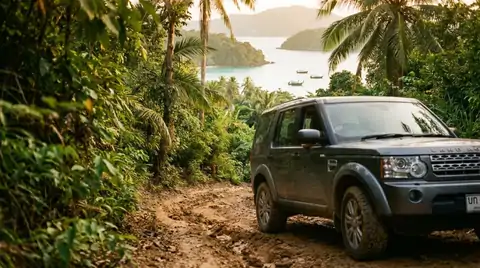
The approaches are surfaced and no four wheel drive is needed for them. An economy car and a compact crossover are equal here, and the difference only appears in an earth overflow area after a downpour, where a low car catches its underside in the ruts left by coaches. If a hill activity park is in the plan, look at the length of the climb, because a weak engine with a full car labours on a long pull and the air conditioning has to be turned down.
The air conditioning is a consumable on these trips. The car stands in the sun for half a day, and the first minutes of the drive back happen in a scorching cabin with the windows open, because cold air does not arrive immediately. Experienced drivers park nose to the south and cover the windscreen with a reflector if one is in the boot.
Luggage. From a water park you come back wet, with bags and packets, and in a small car that becomes a puddle on the seat. A towel on the seat and a bin bag for wet things solve it, while a sun cream stain on light upholstery is discussed separately at the return.
Parking at each type of park
The large parks have their own marked car parks with security and canopies near the entrance. The smaller ones have a verge and a beaten earth area under the trees. The second option looks more convenient right up until it rains: clay holds a wheel perfectly until you try to drive out uphill.
A kerb with a red and white band means no parking, and on Phuket that is not a decorative rule: removal trucks work at popular places and fines reach the rental, which then takes them from the deposit. Red and yellow means stopping to drop off, with no standing.
Parking so you can leave quickly
Park closer to the exit rather than closer to the entrance. When the park closes the whole car park funnels through one arch, and a space by the entrance means an extra twenty minutes in a queue of bumpers.
ImportantA red and white kerb at a park entrance is not a place for five minutes. The truck takes the car to a pound, and the rental invoices the release and the downtime separately from the fine itself.
Parks with children and what changes on the road
With small children the route is built around naps rather than around the park's timetable. A straight road sends them to sleep within fifteen minutes, and waking a child at the entrance is a reliable way to ruin the whole day. A child seat is required in Thailand for the youngest, and rentals provide one on request, though in budget cars the anchor points exist on one row only.
Teenagers care about other things: where to charge a phone and whether there is shade on the car park to wait in. Small details, but they decide whether the drive home passes in silence or in an argument.
The road back from evening shows almost always happens in the dark. Night on the island is genuinely dark: there is lighting in town and on the main roads, while the inland villages have none, and there are scooters without lights and dogs on the verge. Hold a speed below your daytime one.
Two parks in one day
Two large venues in a day work only for people who left early. A realistic pairing looks like this: a water park in the north in the morning, lunch at a shopping centre on the way, an evening show in the east. The transfer between them is about half an hour on inland roads with no traffic and twice that at peak time.
Fuel stations stand on the main roads and not on the inland turnings. Fill the tank before you start rather than along the way, because looking for a pump with a child who needs a toilet is a below average experience.
What not to do
Do not plan a third stop. Phuket eats time in transfers, and by evening a tired family produces an argument about who sits by the window rather than another attraction.
If you are travelling with children, tell us when booking so the seat and the boot space are ready. Message us on WhatsApp with your dates and the ages, or Telegram if you prefer.
Cars for this trip
See all →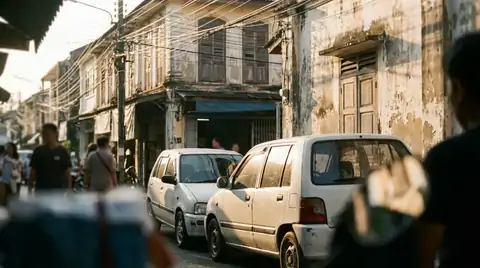
Common questions
How do I drive to the water parks on Phuket?
Most of them stand in the central and northern part of the island near the Thalang road, and the approach comes off the main road by the signs. From the western beaches the drive takes around half an hour and includes the pass, while from town and the airport it is shorter because the road runs straight.
Do the parks have their own parking?
The large ones have marked car parks with security, usually free for visitors. Arrive in the first half of the day, because by lunchtime the nearest rows are full and the shade does not stretch to everybody.
Do I need a four wheel drive for the parks?
No, all the approaches are surfaced and an ordinary small car handles them. Clearance only becomes a subject on earth overflow areas after heavy rain, where a deep rut catches a low bumper.
Where can I go with children by car on Phuket?
The usual pattern for a day is a water or activity park in the first half of the day, an air conditioned shopping centre at lunch, and an evening show nearer the town. More than two stops does not work with children, because transfers across the island take longer than the map suggests.
How long is the drive from Patong to the parks?
From the west coast the drive starts with the pass and takes upwards of half an hour. At the evening peak the jam leaving Kathu is added to that, so allow more time for the return than for the outbound trip.
What if the park car park is full?
Staff usually direct you to an overflow area nearby, most often an earth one. If there is none, look for legal parking on a neighbouring street and read the kerb colour, because a red and white band means removal regardless of there being no space.
Write to us — we will find the right car
We answer in chat: no forms, no phone calls, no waiting on hold.