Stops on the Drive from Phuket to Krabi
The three hours between Phuket and Krabi break comfortably into two or three stops: the cave temple near Takua Thung, the viewpoint over Phang Nga bay and the town market all sit either on highway 4 itself or a couple of kilometres from it. The scheme breaks in exactly one case, when you are driving to a ferry or a flight out of Krabi and your margin is under an hour.
Updated 13 September 2026
- Delivery to your hotel and the airport
- Answers in chat, no phone calls
- We go through the insurance before you sign
What sits along the highway and what a detour costs
The first half of the drive is dull: the Sarasin bridge, highway 402 to the junction at Khok Kloi, then highway 4 east. There is nowhere to stop and no reason to. It starts to mean something after Takua Thung, where a limestone ridge begins on the right, and from there to Ao Luek every point worth slowing for is lined up.
The cave temple of Wat Suwan Kuha stands almost at the roadside: the turning is short, the area in front of the entrance is level, and the detour from the highway takes a few minutes. Monkeys there come right up to the cars, so fold the mirrors and close the windows completely, because a gap of one finger is enough for them.
Samet Nangshe, which not every car reaches
The viewpoint over Phang Nga bay sits on a hill, and the first part of the approach is ordinary tarmac while the final section becomes a steep broken climb that a low car takes reluctantly. There is an area at the foot where people leave the car and go up in local transport. Coming here in the middle of the day makes little sense: the view works at dawn, and dawn means leaving Phuket in the middle of the night.
The town market in Phang Nga works well as a technical pause: it is central, the streets around it are ordinary, and it is the only place on the route where you can properly stretch and buy water. Further east, all the way to Ao Luek, there is nothing comparable.
What it means for the car
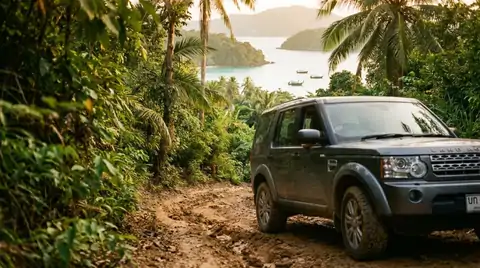
The route itself is handled by an economy car without effort: the surface is even, the climbs are long and gentle, and there are places to overtake. The difference between classes only appears on the turnings, where the road leaves the highway towards a point and two hundred metres later becomes unsurfaced or concrete with a gradient.
On turnings like that a low car has two problems at once: the bumper catches on the change of profile at the entrance, and the front wheels spin on a wet slope. A crossover covers the same two hundred metres without thinking about it. If a hilltop viewpoint is in the plan, the class of car is chosen for that rather than for the highway.
Brakes after three hours of highway
Three hours of steady running at a constant speed means three hours in which the brakes have barely worked, and the first stop at a village traffic light beyond Ao Luek comes out longer than expected. Keep more distance at the end of the route rather than less, even though fatigue pushes you the other way.
One more purely practical point: the air conditioning cools beautifully at speed and less reliably in a stationary car in the sun. Better to find that out at the first pause, while Krabi is still far away and there is somewhere to pull in.
ImportantTurning right back onto the highway when leaving a point is the most dangerous manoeuvre of the whole route. With traffic on the left you are crossing an oncoming stream that does not slow down, and roadside greenery often leaves you with no view at all. It is calmer to turn left, drive to the nearest U turn and come back.
Where to stand at each point
The cave temple has its own marked car park and there is almost always space. The shade is patchy, from individual trees, and an hour in the sun turns the car into an oven, while leaving a window cracked is out of the question because of the monkeys. So there is one option: park under a canopy of leaves and do not linger.
At the foot of the viewpoint the area is compacted earth with no markings. People park as they arrive, and in a tight spot somebody else's car easily blocks your exit. Turning round there is awkward, so drive in facing out from the start.
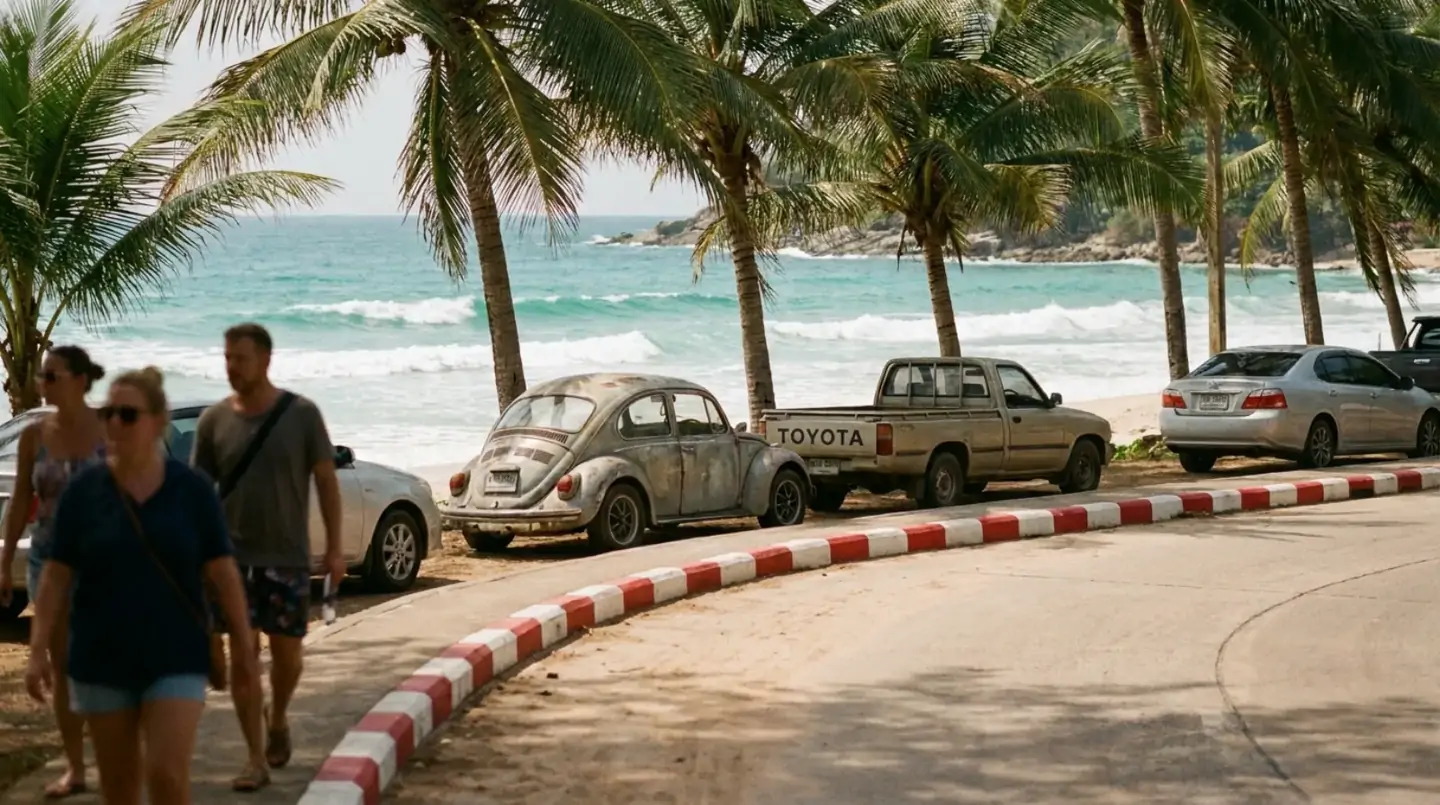
In Phang Nga ordinary town logic applies: a kerb painted black and white means parking is allowed, red and white means it is not. The spaces along the shopping rows are full during the day, but the side lanes always have room, and ninety seconds of walking saves ten minutes of circling.
Take your valuables with you at every stop. These are roadside places with no supervision, and a bag on a back seat is visible to everybody passing.
Fuel and the technical pause
Fuel stations on this route are unevenly spread. They are dense on the 402 before the bridge and around Khok Kloi, then sparse along highway 4, and on the stretch between Phang Nga and Ao Luek they are mostly small village pumps. The rule is simple: fill up before the Sarasin bridge or just after the junction, rather than when you feel like it.
The larger stations have a canopy, water, a toilet and somewhere to stand for five minutes, which is what makes a proper rest stop rather than just fuel. Small village pumps offer none of that.
Half an hour out of the seat matters more than it seems
Three hours at the wheel in an unfamiliar country driving on the left tires you more than the same three hours at home. One stop halfway is not tourism but the way to arrive in Krabi with a working head, and it removes the main risk of the route, which is a lapse of attention on a long monotonous stretch.
Time the pause rather than waiting to feel like it. On a straight road the moment you notice tiredness is already later than the moment it started.
When to skip the stops
If the destination is a ferry or Krabi airport, build the route with no intermediate stops. Every stop adds not only its own time but uncertainty: a U turn, an exit, a missed turning, somebody's car across the way out of an unsurfaced area.
The second case is the rainy season in the afternoon. Unsurfaced turnings soften after a downpour, and a slope taken in first gear when dry is not taken at all when wet. In that weather the hill points come off the list and what is left is whatever stands on tarmac.
The third case is a late departure. The way back in darkness along highway 4 is a different road: unlit sections, bikes without lights on the verge, livestock near the villages. A good stop in the morning beats a poor one in the evening, which is why the whole list of points belongs in the first half of the day.
Enter the points into the navigation app before setting off while you still have signal on Phuket. Between Phang Nga and Ao Luek the network sags, and rebuilding a route on the move does not work everywhere.
If you want the drive planned around a ferry or a flight, tell us the times. Message us on WhatsApp with your dates, or Telegram if you prefer, and we will say what fits and what does not.
TipEnter the points into your navigation app before setting off, while you still have a decent signal on Phuket. On the stretch between Phang Nga and Ao Luek the network drops, and rebuilding a route on the move is not possible everywhere.
Cars for this trip
See all →
Common questions
How long does it take to drive from Phuket to Krabi?
About three hours over roughly a hundred and sixty kilometres, using highway 402 and then highway 4. Add an hour if you plan to stop at the cave temple and the market on the way.
Is the cave temple worth stopping at?
It is right by the road with a short turning and a level car park, so it costs very little time. Fold the mirrors and close the windows completely, because the monkeys there come straight up to the cars.
Can I drive up to the Samet Nangshe viewpoint?
The last part of the climb is steep and broken, and low cars struggle with it, so people usually leave the car at the foot and go up in local transport. The view is a dawn one, which means leaving Phuket in the middle of the night.
Where should I refuel on this route?
Before the Sarasin bridge or just after the Khok Kloi junction, where the stations are frequent and properly equipped. Between Phang Nga and Ao Luek there are mostly small village pumps with nowhere to stop comfortably.
Should I stop at all if I have a ferry to catch in Krabi?
No, build the drive as a straight run with a margin of at least an hour. Every stop adds uncertainty as well as time, and missing a turning on this road can cost several kilometres before the next U turn.
Write to us — we will find the right car
We answer in chat: no forms, no phone calls, no waiting on hold.