
Stops on the Drive from Phuket to Bangkok
The eight hundred and fifty kilometres along highway 4 divide not into sights but into pauses: fuel every couple of hours, lunch at Ranong or Chumphon and a night stop roughly halfway. This is the one route out of Phuket where the stops are a condition of arriving rather than an entertainment.
Updated 13 September 2026
- Delivery to your hotel and the airport
- Answers in chat, no phone calls
- We go through the insurance before you sign
How the route divides
The first leg runs to Ranong. The road goes north on highway 4 with the sea on your left, through Takua Pa and hill sections with real gradients. It is the most scenic part of the journey and simultaneously the most winding: overtakes are short and lorries crawl on the climbs.
The second leg is Ranong and the Kra Isthmus. Here the country narrows so much that less than fifty kilometres separate the Andaman Sea from the Gulf of Thailand, and the road stops weaving. Ranong works well as the lunch point, since the town sits on the highway with fuel stations and roadside food areas around it.
Chumphon as the natural overnight
Then comes a long flat run to Chumphon, and it is on that stretch that drivers most often overestimate themselves. Formally half the distance to Bangkok remains; in practice six or seven hours are already behind you, the hill section included. A night in the Chumphon area splits the route almost in half and turns an exhausting haul into two ordinary drives.
The final leg from Chumphon through Hua Hin to Bangkok is the easiest road and the most demanding traffic. The lanes multiply, the flow thickens, and on the approach to the capital the highway becomes a sequence of interchanges where lane changes are decided in seconds.
What it means for the car
This is the one route from the island where the class of car is chosen for endurance rather than clearance. Twelve hours on a highway make three things decisive: the driving position, the noise level, and an air conditioning system that holds a temperature for hours without fading. An economy car physically gets there, but by evening the difference from a class above is felt in your back.
Consumption on a run like this is higher than in town, not because of traffic but because of sustained speed and the air conditioning at full. Do not plan the tank down to nothing on the hill section between Takua Pa and Ranong: stations exist there, but the gaps between them are noticeably longer than on flat ground.
Tyres and pressure over a long run
Checking pressures before a distance like this is not a formality. An underinflated tyre heats over three hundred kilometres of even highway, and that is exactly how tyres end on rental cars that have previously only done short island hops. The check takes five minutes at the first fuel station.
A word about lights. The return leg, or the second day of the trip, almost always includes darkness, and on the unlit sections of highway 4 oncoming main beam blinds you for a long time. The inside of the windscreen has to be clean, because a hazy film turns every approaching lorry into a flash.
ImportantDriving to Bangkok in a single day is the main risk of this route. After the tenth hour at the wheel concentration fails without warning, and the hill section has already taken more out of the driver than it seemed to. A night halfway is cheaper than any consequence, and no insurance covers a driver who fell asleep.
Where to stop on the long pauses
The main format of a stop on this route is a large chain fuel station. There is a canopy, a toilet, a shop, coffee and, most importantly, a flat area where you can get out and walk. Those stations appear regularly along highway 4 and are visible from a distance.
Roadside food areas usually offer their own parking right in front. Drive in nose first, planning to leave without turning round: the areas are narrow and lorries park wherever they like.
In the towns along the route, Ranong, Chumphon and Hua Hin, ordinary urban parking rules apply and they are the same as in Phuket: a black and white kerb means parking is allowed, red and white means a prohibition with real removal. In an unfamiliar town after a long drive it is simpler to use a paid area than to work out the markings.
Stop before you feel you need to. On a route of this length the pauses that matter are the ones taken on a schedule rather than on a feeling.
Documents and checks on the highway
The route crosses several provinces, and permanent checkpoints on highway 4 appear regularly. Vehicles are stopped selectively and the licence and vehicle documents are inspected. A home licence together with an International Driving Permit and the rental agreement in the glovebox settle it in a minute.
What should be in the car
The rental agreement, the insurance policy, a copy of the vehicle document and both driving permits. All of it is provided when the car is collected, and it is sensible to check the set before leaving rather than at a checkpoint six hundred kilometres from the office.
Speed limits change along the highway, and the difference between a built up area and open road is substantial. Cameras stand more often at the entrances to towns than on the open stretches, and fines reach the rental company and are then passed on to the renter.
Keep a photograph of the agreement on your phone as well as the paper in the glovebox. If the car changes hands between two drivers mid trip, both of you want access to it.
Who this route does not suit
A driver with no experience of driving on the left. Twelve hours is not the distance on which to get used to a new side of the road: fatigue brings back old reflexes, and that is most dangerous at U turns and when pulling out of fuel stations.
A one way trip with the car returned in Bangkok. An intercity drop off is arranged separately and is not always possible, and that question is settled before booking rather than on the road.
And a trip with a rigid schedule at the far end. The route holds too many variables: the hill section, the weather, the density of traffic on the approach to the capital. A margin of several hours over a distance like this is normal planning rather than caution.
For most visitors the honest comparison is with a flight, and the drive only makes sense if the journey itself is part of the plan. If it is, split it over two days and enjoy the isthmus rather than enduring it.
If you are considering this drive, talk to us before booking the car. Message us on WhatsApp with your dates and whether you need a drop off at the other end, or Telegram if you prefer.
TipDownload the route for offline use before setting off. On the hill stretch between Takua Pa and Ranong the signal drops out in places, and a navigation app without offline maps shows an empty screen exactly there.
Cars for this trip
See all →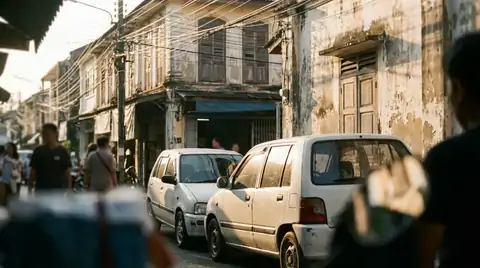

Common questions
How long does it take to drive from Phuket to Bangkok?
Around twelve hours of driving time over roughly eight hundred and fifty kilometres, before any stops are counted. With pauses and a meal that becomes a very long single day, which is why most people split it overnight.
Where is the best place to stop overnight?
Around Chumphon, which divides the route almost in half and comes after the demanding hill section. Stopping there turns an exhausting haul into two ordinary drives.
Can I return the rental car in Bangkok?
Sometimes, but an intercity drop off is arranged separately and is not always available. Settle that before booking rather than assuming it can be organised from the road.
How often should I stop on this drive?
Every couple of hours, using the large chain fuel stations along highway 4 where there is shade, a toilet and room to walk. Taking pauses on a schedule rather than when you feel tired is what keeps the second half of the day safe.
Is this route suitable for a first time visitor to Thailand?
Not if you have never driven on the left, because fatigue brings back old reflexes over a distance like this. It is a route for somebody already comfortable with local roads and willing to split it across two days.
Write to us — we will find the right car
We answer in chat: no forms, no phone calls, no waiting on hold.