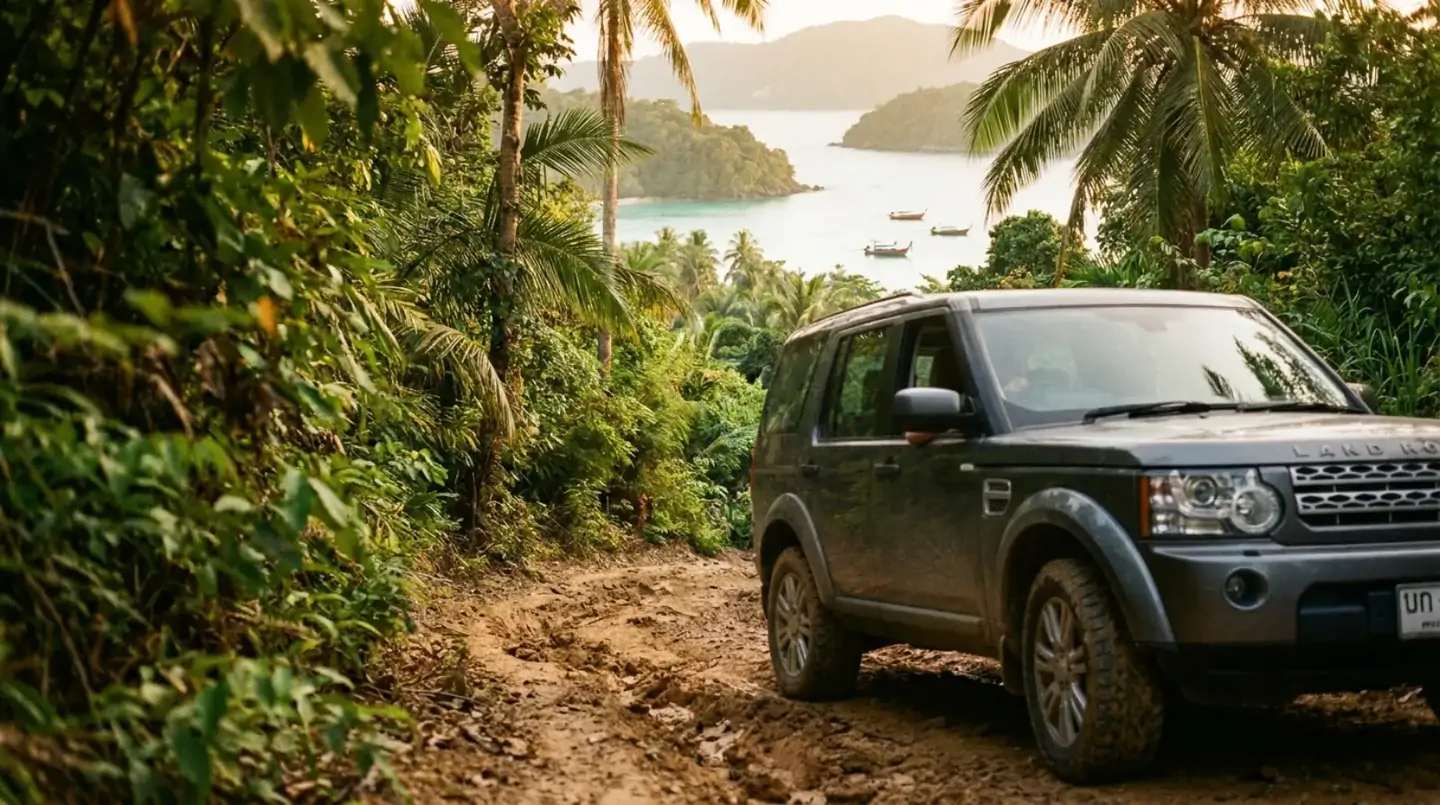
Driving to Wat Chalong Temple, Phuket
The main temple of the island stands on a busy road a little north of the Chalong roundabout, and the approach is limited not by distance but by traffic: exits appear on both sides continuously, and the way in runs through a gate with a kerb. Everything difficult about this trip happens in the last two hundred metres.
Updated 13 September 2026
- Delivery to your hotel and the airport
- Answers in chat, no phone calls
- We go through the insurance before you sign
The approach and driving in
The road the temple stands on is one of the busiest in the southern part of the island. There are few lanes, the traffic is dense, bikes run along the verges, and exits from yards and forecourts appear every few dozen metres. Driving past your turning here is easy, and turning round afterwards does not happen quickly.
The entrance to the grounds is a gate. The opening is wide for one car and narrow for two, and a kerb runs along its edges which a low front bumper catches if you enter at an angle. Go in straight and slowly, and only after making sure nothing is coming out.
What happens inside
Beyond the gate a yard opens in which cars, bikes, pedestrians and tour coaches all move at once. There are no traffic rules there; only walking pace and constant mirror work function. A pedestrian in a place like that is right by fact rather than by agreement.
The coaches occupy their own part of the yard and manoeuvre widely. Parking tight against their area is a reliable way to discover that you cannot leave until a coach has finished turning.
What that means for the car
The class of car is irrelevant here: asphalt all the way to the grounds and inside them. Size and visibility are what matter. A compact economy car is at ease on this yard, a minivan is an elephant in a corridor and every manoeuvre takes two movements.
A word about mirrors. Bikes ride constantly between the rows of parked cars, and a folded mirror is not excessive caution but the way to keep it. Unfold it just before you rejoin the road.
Rejoining the traffic
Coming out of the grounds onto that busy road is the riskiest moment of the whole trip. With traffic on the left you join the left hand flow and must look right, but you have to check both sides, because bikes regularly run along the edge against the general direction.
A pause of a few seconds before pulling out settles the whole question. Whoever is sounding a horn behind you will not be paying for the accident investigation, and that is worth remembering every time the urge to hurry appears.
ImportantA bike in the blind spot as you leave the temple grounds is the most common contact scenario in this area. Two wheelers run tightly along the verge and appear in the mirror at the last moment. Look over your shoulder rather than only in the mirror, and pull out in one confident movement without stopping across the lane.
Where to park
The yard inside the grounds is the main option, and in the morning there is plenty of room. By the middle of the day it fills with coaches and cars, leaving spaces along the far edge, which is a slightly longer walk but a calmer exit.
Park nose outwards. Turning round on a full yard with bikes and pedestrians around is several minutes of manoeuvring under other people's gaze, and doing it at the end of a visit is no pleasure at all.
Shade and animals
There is shade at the edges of the yard under the old trees. You pay for it with fallen leaves and, occasionally, with the attention of animals: close the windows fully and do not leave bags of food visible in the cabin.
Parking along the road outside the grounds is technically possible but it is the worst option: the verge is narrow, the traffic dense, and passengers get out directly into the lane the bikes are using.
Clothing, timing and conduct
Shoulders and knees covered is the rule for everybody going inside the buildings. A wrap and longer shorts in the car settle the question, and shoes come off before entering in any case, so sandals are the practical choice.
Early morning is the best time. The yard is free, the coaches have not arrived, the paving on the grounds is not yet scorching, and rejoining the traffic afterwards is noticeably easier than in the middle of the day.
The market rows nearby
Trading rows operate around the temple, and they create additional pedestrian traffic straight across the driving lanes. During the busy trading hours keep the speed very low both on the approach and inside the yard, because people step out between cars without looking.
Fitting the temple into a day
The Chalong roundabout is the junction from which roads run south, west and up into the hills. The temple stands beside that junction, so the most logical place for it is the first stop of the morning, after which you head off in whichever direction you need without doubling back.
A good pairing is the temple and the climb into the hills: both require covered clothing, both are more comfortable early, and both sit on the same axis from the roundabout. The only difference is the road, level to the temple and a hill road upwards.
If the south of the island follows the temple, it is convenient to leave the roundabout towards the coast. There is no sense in coming back to the junction for a different direction, because it is the one congested node in the district and each extra pass through it costs time.
Tell us which of these days you are planning and we will match the car to them. Message us on WhatsApp with your dates, or Telegram if you prefer.
TipSet the navigation to the entrance of the grounds rather than to the temple itself. The difference is a hundred metres, and it decides whether you arrive at the gate or drive past it in dense traffic with nowhere to turn round.
Cars for this trip
See all →
Common questions
Does Wat Chalong have its own parking?
Yes, cars drive into the grounds through a gate and park on the common yard. It is free in the morning, and by the middle of the day the coaches take it over, leaving spaces along the far edge.
Is it hard to drive into the temple grounds?
The gate opening is wide for one car, but a kerb runs along its edges which a low bumper catches if you enter at an angle. Go in straight and slowly, having first made sure nothing is coming the other way.
When is the best time to drive to the temple?
Early morning, when the yard is free, the coaches have not arrived and rejoining the busy road is much easier. In the middle of the day the trading rows are working and pedestrians walk straight between the parked cars.
Can I park on the road by the temple?
Technically yes, but it is the worst option available. The verge is narrow, the traffic on that road is dense, and passengers step out directly into the lane the bikes use.
Is there a dress code for visiting?
Shoulders and knees must be covered by anyone entering the buildings. Keeping a wrap and longer shorts in the car is easier than solving it at the entrance, and shoes are removed before going in.
What is the riskiest part of the trip?
Pulling out of the grounds back onto the road, because bikes run tightly along the verge and appear late in the mirror. Look over your shoulder and join in one movement rather than stopping across the lane.
Write to us — we will find the right car
We answer in chat: no forms, no phone calls, no waiting on hold.