
West Coast Beaches of Phuket by Car
The west coast is an unbroken chain of beaches from Mai Khao in the north to Nai Harn in the south, linked by one road that comes out to the sea and then turns back into the hills. You can drive the whole thing in a day, but every pass between the bays takes more time than the map promises.
Updated 13 September 2026
- Delivery to your hotel and the airport
- Answers in chat, no phone calls
- We go through the insurance before you sign
How the coast road works
There is no single road running along the whole west coast. There is a chain of segments: a descent to a bay, the bay itself, a climb and a pass, the next bay. Between the northern beaches the road is almost flat, and south of Kamala real terrain begins, with bends and gradients.
The north, meaning Mai Khao, Nai Thon, Nai Yang and Bang Tao, passes quickly and calmly. Then come Surin and Kamala, and after them the densest section: Patong, the pass to Karon, Kata and the descent to Nai Harn. Here the speed falls and the traffic thickens.
How much time to allow
The whole coast with stops needs a full day. If the aim is simply to see the coastline, half a day is enough, but then you have to choose: either the north with its wide empty beaches, or the south with its bays and viewpoints.
What that means for the car
The main load is the passes. The descent towards the Karon and Kata side is long, and the brakes heat up if you ride the pedal instead of using a low gear. Come down in a limited gear, letting the engine hold the car, and use the pedal in short applications.
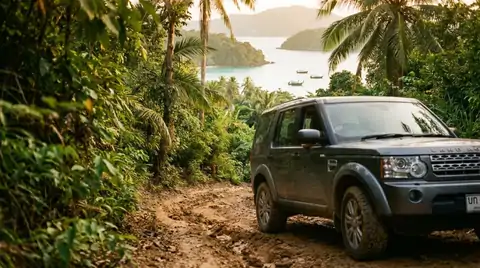
Ground clearance is not needed everywhere, but it is useful. The tracks down to the wild beaches between the bays run on earth, and a low car catches its underside in the ruts. A crossover closes that question, while an economy car is fine on asphalt and simply does not attempt the distant tracks.
Sand and salt. A car standing right by the shore collects a film over the course of a day and it shows on the paintwork. A wash after a day like that is ordinary local practice, and rentals take different views of a car returned dirty, more often a strict one.
Fuel along the route
Stations stand in the larger districts, at Bang Tao, Patong, Kata and on the approaches to town. Between the bays there are none, so fill the tank at the start rather than on the last segment of the gauge.
Where to park at each beach
The northern beaches are generous: wide verges, earth areas under the trees, free spaces almost always. Nai Yang and Nai Thon are the same, with a row of cafes along the road.
Bang Tao and Surin are already tighter: paid parking is marked at the beach entrances and no parking signs stand along the road. Kamala is calmer, with parking along the seafront, though in high season there is nothing free in the evening.
Patong is the hardest. The streets are narrow and one way, the car parks paid and full, and removal is active. It is simpler to leave the car in the multi storey park at the shopping centre and walk. Karon and Kata are easier, with bays along the road above the beach, and Nai Harn has the area by the lake.
ImportantFrom May to October the west coast runs surf with rip currents, and a red flag means swimming is prohibited rather than discouraged. On days like that it is more sensible to drive to the southern bays or to the eastern side of the island than to argue with the sea.
How the beaches differ from a driver's point of view
The north means long straights, easy parking and few people, at the price of driving to reach a cafe or a shop. The central part means dense building, many turns, evening congestion and full car parks. The south means beautiful bays, steep descents and climbs, and narrow roads with no verge.
For a first day at the wheel the north is the best option, because it is calm and mistakes there are cheap. Leave Patong and the southern hill roads for your third or fourth day, once driving on the left has stopped requiring effort.
Wild beaches exist between the larger bays, reached by unsigned earth tracks. Do not go down them in rain: the climb back up wet clay is much harder than the descent was.
Building one day along the west
A workable plan: start at seven or eight in the morning from the north, swim at an empty Nai Yang, coffee at Bang Tao, then Surin and Kamala. Lunch in Patong, or in Karon if you would rather avoid the crowd. In the evening the viewpoint above Kata and sunset at Nai Harn.
The transfers on that route are short, with the longest being Kamala to Patong over the pass. The drive home almost always happens in the dark, and on the southern hill roads at night the speed should come down.
For anyone staying in the east or in town, it is easier to join the coast in the middle, through Kata or Patong, and pick one direction. A day assembled from both ends of the coastline turns into a race with no stops.
If you want a car that handles both the coast road and a track to a wild beach, say so when booking. Message us on WhatsApp with your dates, or Telegram if you prefer.
Cars for this trip
See all →

Common questions
Can I drive all the west coast beaches in one day?
You can, if you start early and stay no longer than an hour at each stop. It is genuinely more enjoyable to split the coast in two: the north with its wide empty beaches and the south with its bays and viewpoints.
How do I drive from Patong to Karon and Kata?
The road runs over a pass on a short hill section with tight bends. Come down in a low gear so the engine does the braking rather than the pedal, because the pads heat faster on that stretch than anywhere else on the island.
Where do I park on the west coast beaches?
In the north there are plenty of verges and earth areas under the trees, while Bang Tao and Surin have marked paid parking. In Patong it is easier to use the multi storey park at the shopping centre and walk, because kerbside spaces are taken and removal operates constantly.
Do I need a crossover for the west coast?
For the surfaced coast road an ordinary small car is enough. Clearance matters only if you plan the earth tracks down to the wild beaches, where the ruts catch a low car, especially after rain.
When is swimming unsafe on the west coast?
From May to October the west runs surf with rip currents and red flags go up on the beaches. A car lets you move to somewhere calmer, either the southern bays or the eastern side of the island.
Which part of the coast suits a first day of driving?
The north, because the roads are wide, the traffic is thin and parking is easy. Patong and the southern hill roads are better left until driving on the left has become automatic.
Write to us — we will find the right car
We answer in chat: no forms, no phone calls, no waiting on hold.