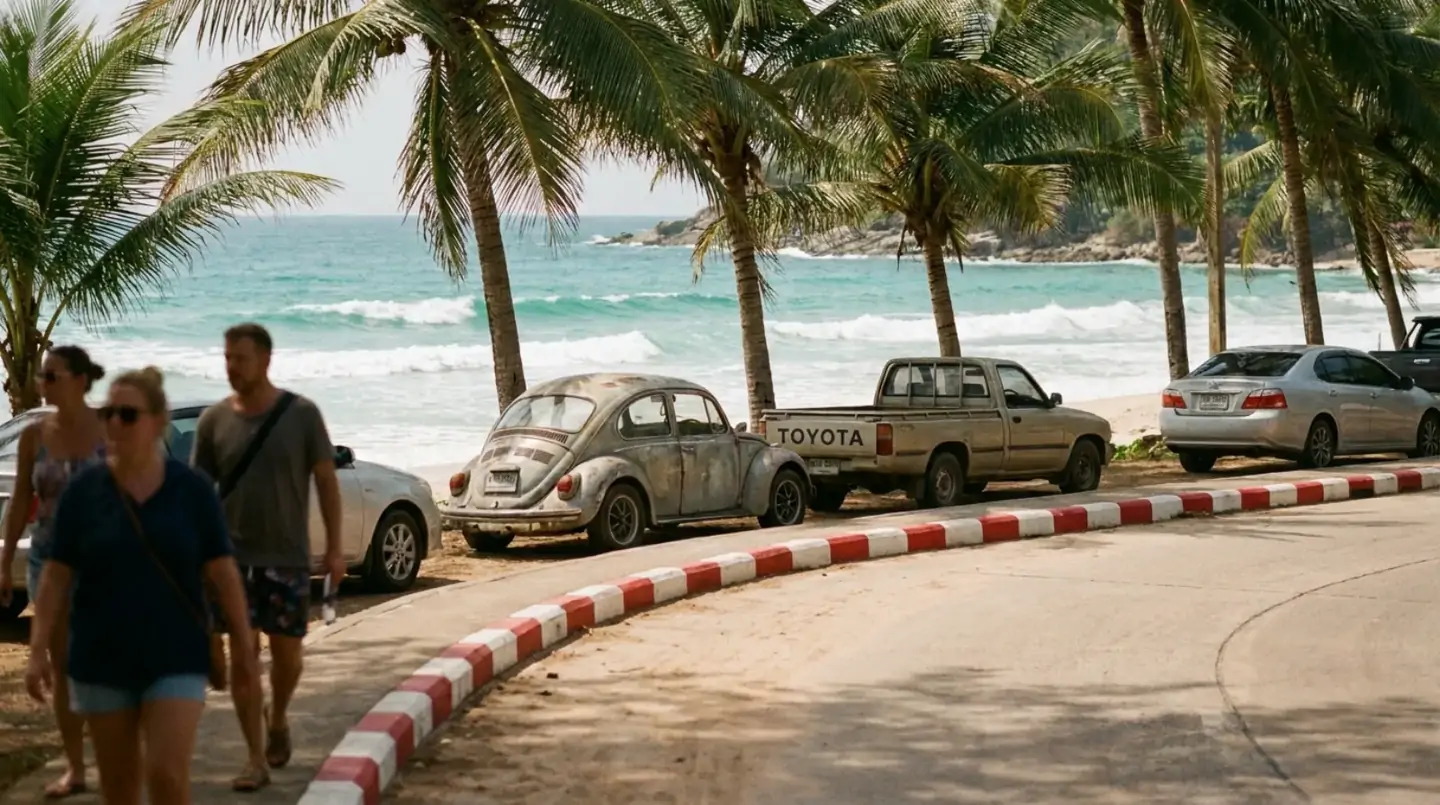
Phuket to Hua Hin by Car
From Phuket to Hua Hin is roughly 650 kilometres north along highway 4 and nine to ten hours of driving, which makes it a trip with a night on the way rather than a single day's run. People who do it in one go give the entire daylight to the wheel and arrive wrung out.
Updated 13 September 2026
- Delivery to your hotel and the airport
- Answers in chat, no phone calls
- We go through the insurance before you sign
Is it worth driving yourself
People drive to Hua Hin for the road itself and for the freedom once they arrive. Hua Hin is a resort town in Prachuap Khiri Khan province, stretched out along the coast, and without a car you spend the whole stay calling for one. Arrive in your own and that question is closed for the whole trip.
The second argument is the stops along the way. Highway 4 runs the length of the country's western coast, and Takua Pa, Ranong and Chumphon lie on it, places nobody drives to specially but which make sense to look at in passing.
Who this drive does not suit
Anyone counting on doing it in a day. Nine to ten hours is pure driving, without fuel stops, lunch or stretching, and with those the day stretches to twelve and ends with entering an unfamiliar city in the dark. A family with small children also finds the route hard, because there is nothing along the road to occupy them and the section through the hills brings on travel sickness.
If the trip is planned for three or four days, the road eats two of them. From a week upwards the arithmetic changes and the drive pays for itself.
The route in sections
The start is the same as for any departure from the island: the Sarasin bridge, road 402, the interchange at Khok Kloi. There the route turns north onto highway 4, also signed as Phetkasem, and you do not leave it again until Hua Hin.
The first leg runs to Takua Pa. The road follows the coast, wide, with settlements every few kilometres, and the average speed stays moderate because of the constant village limits.
The slowest part is between Ranong and Chumphon
Here the highway climbs into the hills: bends, long ascents and loaded lorries crawling up them in second gear. You end up overtaking often, and there are few places where overtaking is safe. When you plan the timing, allow more for this stretch than the navigation app suggests.
Around Ranong the road crosses the Kra isthmus, the narrowest part of the country, where the coast and the border sit close together. Past Chumphon the terrain lets go: the highway straightens, lanes multiply, and the rest of the way through Prachuap Khiri Khan province and Pran Buri passes quickly and smoothly.
- Sarasin bridge, road 402, Khok Kloi interchange
- North on highway 4 to Takua Pa
- Hills between Ranong and Chumphon, the slow part
- Fast straight running from Chumphon to Hua Hin
What that means for the car
Six hundred and fifty kilometres of highway is the one scenario on Phuket where the engine matters more than the ground clearance. A small economy car will complete the drive, but on the climbs between Ranong and Chumphon it takes a long time to get past a lorry, and a long overtake on the opposite carriageway is exactly what you do not want in the hills. A crossover or something a class higher pays for itself here in torque rather than in comfort.
Tyres and air conditioning
Tyres are checked before you leave, not on the road: worn tread grips less on hot highway asphalt and at speed that shows itself in the bends. Look at the spare and the jack in advance too, because finding them for the first time on the verge of a highway is a poor experience.
The air conditioning on this distance runs without a break for ten hours. If it cools weakly in town, it will not improve on the road, and the cabin becomes a sauna by evening. The simple pre departure check is to sit with the engine running and the cooling on without moving.
You will need the main beam. The stretches between towns have no lighting, the markings are worn in places, and at night people walk along the verge and scooters ride it without lights of their own.
ImportantCheck in the rental agreement whether leaving Phuket for the mainland is allowed and how far. Some rentals limit the territory of use, and outside the permitted zone the insurance does not respond to a breakdown or an accident, while recovery across half the country comes out of the deposit.
The overnight stop and the breaks
There are two logical places to stop for the night: Ranong and Chumphon. Ranong is closer to Phuket, so stopping there makes the first day short and the second long. Chumphon splits the route more evenly, but you have to get through the hills to reach it.
In practice it is better to leave early and sleep in Chumphon. The difficult section is then covered in daylight with a fresh head, and the second day is level fast road on which you reach Hua Hin before dark.
Where to stop along the way
The large fuel stations on highway 4 work as full service stops: food, coffee, clean toilets and shade over the forecourt. Roadside kitchens in the villages are more interesting, but they cost time and the car stands unattended on the verge.
At the overnight stop everything comes out of the cabin and into the boot. A rucksack left on a seat in an unfamiliar car park is an invitation, and that rule works the same in every town along the road.
Arriving in Hua Hin and parking
The highway enters the town from the north and becomes the main street. Traffic here is denser than on the open road but noticeably calmer than in Patong: more lanes, better organised flow, fewer scooters.
Parking in the centre, at the night market and along the seafront is full in the evening. Hotels almost always provide their own spaces, so it is easier to leave the car there and walk into the centre or take a short loop around the congested street.
Kerbs and fines
The colour rule works across the whole country and this town is no exception: a red and white band means no parking. Fines are issued as a sticker on the glass, and in a tourist centre in season that is done regularly.
Plan the return the same way as the outbound trip, with a night in the middle. Trying to get back to Phuket in one push after several days of holiday is harder than the drive out, because by then the sleep deficit has already accumulated. Tell us your dates on WhatsApp, or Telegram if you prefer, and say if you want the car for a mainland trip.
TipLeave Hua Hin at first light for the return. The first hours on highway 4 are nearly empty, in three hours you cover a third of the route, and the rest of the day stays free for the slow section in the hills.
Cars for this trip
See all →

Common questions
How long does it take to drive from Phuket to Hua Hin?
Around 650 kilometres and nine to ten hours of driving on highway 4. With fuel, food and stretching the day extends to twelve hours, which is why the route is planned with a night stop.
Where should I stay overnight on the way?
The two logical points are Ranong and Chumphon. Chumphon divides the route more evenly and also lets you cross the hilly section in daylight rather than after dark.
Which part of the road is the hardest?
The stretch between Ranong and Chumphon, with hills, bends and long climbs where lorries crawl and force you to overtake. It takes more time than the navigation app promises.
Can I reach Hua Hin in a single day?
Physically yes, if you leave before dawn and barely stop. You will arrive in the dark, tired, in an unfamiliar city, which is why very few people do it that way.
What kind of car suits this distance?
One with enough torque to overtake on the climbs and air conditioning that works for ten hours without a pause. A small economy car will complete the route, but every lorry you pass will take a long time.
Do I need special insurance for a long trip?
No special cover is needed, but the territory of use in the agreement is worth checking, since some rentals restrict leaving the island. Outside the permitted zone the cover does not apply at all.
Write to us — we will find the right car
We answer in chat: no forms, no phone calls, no waiting on hold.