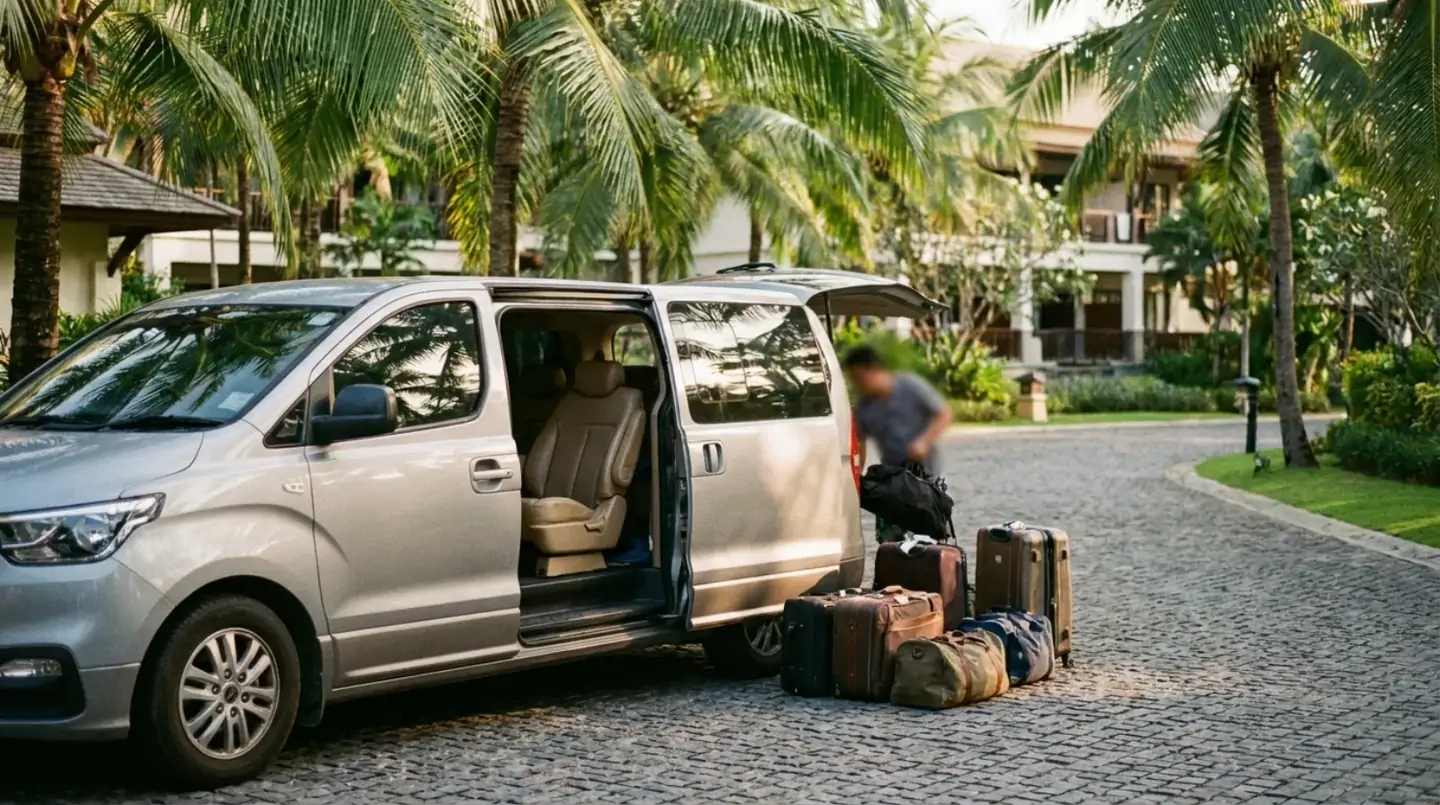
Phuket to Hat Yai by Car
From Phuket to Hat Yai is roughly 470 to 500 kilometres and about seven hours of driving: the Sarasin bridge, road 402, then highway 4 east through Phang Nga and Krabi, and south through Huai Yot, Trang and Phatthalung. Do not go there for the sea, because Hat Yai sits inland; people who want a beach drive on to Songkhla.
Updated 13 September 2026
- Delivery to your hotel and the airport
- Answers in chat, no phone calls
- We go through the insurance before you sign
Why people drive there and how long it takes
Hat Yai is the largest city in Songkhla province and the main commercial hub of the south. People drive there to shop, to see a doctor, to change transport, and simply to look at a normal Thai city without a tourist front. The sea is not part of the trip, since the coast starts at Songkhla and that is a separate outing.
Seven hours of driving means a full day on the road with something in reserve. Leave in the morning, arrive in the evening, and you have had lunch and stretched your legs twice on the way.
Why it is easier than it sounds
The route is almost entirely flat. There are no serious passes on it, long sections run as a wide road with a central divider, and the average speed holds higher than on any mountain direction. The difficulty is length rather than terrain: seven hours of monotonous highway tire you precisely because nothing happens.
Returning the same day is physically possible and amounts to fourteen hours behind the wheel. A night in the city removes that question entirely and turns the drive back into an ordinary day.
The route in sections
The first part is familiar to anyone who has driven to Krabi: the Sarasin bridge, road 402, the interchange at Khok Kloi, and then highway 4 heading east through Phang Nga. The road is wide and the traffic calm, with villages appearing regularly and taking the speed back down each time.
Past Krabi the route turns south and stays on highway 4, running through Huai Yot towards Trang. That leg is the flattest of all: plantations on both sides, long straights, few settlements to slow you.
From Trang to the city
From there the road goes to Phatthalung and then east to Hat Yai. Closer to the city the traffic thickens: lorries appear, pickups loaded to the roof, and dense rows of scooters along the verge. Your speed drops several dozen kilometres before you actually reach the outskirts.
Signs along the route are duplicated in Latin script and getting lost is difficult, because highway 4 runs as a single thread. Keep the navigation on around the Trang interchanges all the same, since several exits come one after another there.
- Sarasin bridge, then road 402 to Khok Kloi
- Highway 4 east through Phang Nga to Krabi
- South through Huai Yot to Trang
- Phatthalung, then east into Hat Yai
What that means for the car
Ground clearance is irrelevant on this route. The road is level, the surface is kept in decent condition, and an economy class car handles the drive without any qualification. The load falls on the air conditioning and on the driver rather than on the suspension.
What actually needs checking
Cabin cooling at idle, the state of the tyres and the main beam. Seven hours heading south means hot asphalt, straight sections where speed is held for a long time, and a return in the dusk if you linger in the city.
A crossover makes sense here for the boot rather than for going off road: people come back from Hat Yai with shopping, and volume suddenly matters more than clearance. For a family driving down specifically to buy things, a minivan closes the question more reliably.
Screen wash disappears faster on the highway than in town, because of dust, insects and spray thrown up by lorries. An empty reservoir three hours into the drive turns the windscreen into a milky film, and against a low sun that is genuinely dangerous.
Driving inside Hat Yai
The city lives on trade and the roads show it. In the central blocks traffic is dense all day, and there are so many two wheelers that they effectively set the rhythm: a bike passes you on the right, on the left and on the wrong side of the road, and treats none of that as remarkable.
Keeping more distance than you would at home and checking the mirrors before every lane change is the only tactic that works. Sharp manoeuvres do not survive in that kind of traffic, because there is almost always somebody between you and the next lane.
Left hand traffic and turning
Driving on the left in a busy city feels different from driving on the left on an empty highway. The commonest visitor mistake is turning into the right hand lane out of habit, and it happens exactly where a junction has many lanes and no markings.
Pedestrians cross wherever they happen to be, and in the shopping blocks that is normal. Speeds in the centre stay low not because of the signs but because nothing else is possible.
ImportantFines are issued far more often in a large city than in the tourist districts of Phuket: the junction cameras work, and the notice reaches the rental and is taken from the deposit after you have already returned the car. Seat belts, speed and the no parking rule at a red and white kerb are taken seriously here.
Where to park in the city
Parking in Hat Yai is arranged better than on the island. The shopping centres have multi storey covered structures, and in the heat that is the best option available: the car does not bake and the exit leads straight into the gallery.
Hotels in the centre usually have few spaces of their own and they are taken by the evening. Arriving late, be ready to use a paid area in the next block instead.
The street in the shopping blocks
There are spaces along the streets but they rarely free up, and in the evening the density of cars is joined by street kitchens putting tables straight onto the pavement and partly onto the carriageway. Do not park somewhere you will later have to reverse out of through a crowd.
Kerb colours read the same as everywhere in the country. A red and white band means no parking, and in the centre that is enforced rather than suggested.
TipLeave the car in a covered shopping centre park and move around the centre on foot. The blocks are compact and close together, and the time you would spend hunting for a kerbside space is time spent sitting in traffic.
Cars for this trip
See all →

Common questions
How long does it take to drive from Phuket to Hat Yai?
Around 470 to 500 kilometres and about seven hours of driving. With stops for food and fuel it becomes a full day on the road rather than a half day trip.
Is there a beach in Hat Yai?
There is no sea in the city itself, which sits inland from the coast. The nearest water is at Songkhla, and that is a separate short drive from the city.
Is the road to Hat Yai difficult?
The route is almost entirely flat with no passes, and long sections run as a wide divided road. What tires you is the monotony and the distance rather than the driving itself.
Which car suits the trip to Hat Yai?
Ground clearance is not needed and an economy class car is enough. Look at the size of the boot instead, because people usually come back from the city with shopping.
Where do I park in Hat Yai?
The covered car parks at the shopping centres are the most comfortable option, since the car stays cool and the centre is walkable. Hotels have few spaces of their own and those are taken by the evening.
Can I drive there and back in one day?
Technically yes, but that is about fourteen hours at the wheel before you do anything in the city. An overnight stay turns it into a normal trip rather than an endurance exercise.
Write to us — we will find the right car
We answer in chat: no forms, no phone calls, no waiting on hold.