
Stops on the Patong to Phuket Town Road
A pass lies between Patong and Phuket Town, and the whole drive is a climb, a descent and a town section at the end, about half an hour with no traffic. There are few stops on it, but each is tied to the terrain: the pull-in at the summit, the commercial strip in the valley, and the entry into town where a completely different kind of driving begins.
Updated 13 September 2026
- Delivery to your hotel and the airport
- Answers in chat, no phone calls
- We go through the insurance before you sign
What the road consists of
Out of Patong the road turns upwards immediately in a series of bends. The climb is continuous, in places with one lane each way, and there is almost always something heavy crawling ahead. There is nowhere to overtake on that section and no need: the gain is a minute and the risk is out of proportion.
At the summit there is a pull-in where you can stop and look down over the bay. It is small, taking only a few cars, and you have to slow well before it, because spotting it at the last moment and braking hard on a climb means collecting a bike in the boot.
The descent into the valley
The descent from the pass towards Kathu is longer than the climb and runs at a constant gradient. This is the main technical section of the route, and it is where the brakes overheat for anybody riding the pedal all the way down. A low gear solves the problem completely.
In the valley ordinary life begins: a commercial strip, fuel stations, roadside shops. It is the one place on the route with proper parking areas where you can stop calmly, so any errands belong here rather than in town.
What that means for the car
The pass is a short but honest test for a loaded car. A full cabin and boot make the gearbox change down constantly on the climb, the revs stay high and the air conditioning loses its cold. That is normal, but if a car breathes like that on a twenty minute pass, a full lap of the island with the same load needs planning differently.
On the descent the problem is the reverse. A brake pedal held down over kilometres heats the mechanism, and by the bottom the pedal travel becomes longer and softer. The correct method is a low gear with short applications of the brake, letting it cool between them.
Bikes on the pass
There are a great many two wheelers on this road and they behave in different ways: some crawl uphill along the edge, others overtake on the wrong side in a bend. Keep more distance than usual, and before every blind corner assume somebody is about to appear from it.
In rain the surface on the bends becomes noticeably slippery, especially in the first minutes of a downpour when water lifts the accumulated oil film off the asphalt. On the descent at that time, reduce speed before it feels necessary.
ImportantOverheating the brakes on the descent from the pass is not theory but a regular scenario for anyone driving in hills for the first time. There is one sign: the pedal goes soft and travels deeper. At that moment stop at the nearest safe place and wait for the brakes to cool. Continuing down on a pedal like that is not an option.
Where to stop on the way and in town
On the pass, only in the pull-in at the summit, and only if there is room. The verge on the bends is narrow, oncoming traffic comes around the corner, and a car abandoned on the edge becomes an obstacle visible one second before contact.
In the valley the parking areas are ordinary ones at shops and fuel stations, level and roomy. That is the best place on the route to stretch, fill the tank and work out the rest of the way.
Phuket Town
The town has its own logic. The central streets are narrow, some of them one way, and cars stand along the kerbs. Hunting for a free street space during working hours is a way to lose twenty minutes, so drive straight to a paid or multi storey car park instead.
Kerb colour in town means exactly what it says: red and white is a ban and removal operates. Parking fines under a rental agreement reach the renter through the company, so nobody noticing is not a thing that happens here.
Traffic and when to set off
The road over the pass is the main link between the west coast and the town, and in the morning and evening hours it stands still. Twenty minutes becomes forty or more, and it is the climb that stops, where there is nowhere to overtake.
A queue on a climb is unpleasant less for the lost time than for the heat: the car crawls in first gear, there is no airflow, and the air conditioning runs at full output. Watching the engine temperature at that moment is sensible habit rather than paranoia.
When to go
The freest times are the middle of the day and late evening. If the trip into town is planned, for paperwork, a shop or an office, put it at ten or eleven in the morning, once the morning flow has passed and before the lunchtime one starts.
Who finds this route hard
Anyone driving in hilly country for the first time. The pass is short but it demands correct use of the gears, and learning that on a descent surrounded by bikes is not the best scenario.
Drivers of a fully loaded economy car. It will make the trip, but the climb will be strained and the descent will need particular attention to the brakes, because the mass is greater and so is the momentum.
And everybody in a hurry. This section does not forgive haste: overtaking on the bends, braking hard before the pull-in, trying to squeeze through a junction in town, all three mistakes come from being ten minutes short in the schedule.
If town days and coast days are both in the plan, tell us and we will match the car. Message us on WhatsApp with your dates, or Telegram if you prefer.
TipIf you are driving into town for the first time, set the destination to a multi storey car park near the centre rather than to an address in it. You then arrive where the car can actually be left instead of circling the one way streets.
Cars for this trip
See all →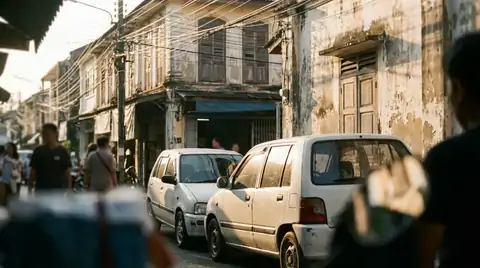
Common questions
How long does it take to drive from Patong to Phuket Town?
About twenty minutes with a clear road and up to forty in the morning and evening peaks. The main delay falls on the climb over the pass, where there is nowhere to get past slow traffic.
Is the pass between Patong and Phuket Town dangerous?
In itself it is passable for any car, and the risk lies in the descent, where a long gradient on a held brake overheats the mechanism and the pedal goes soft. Come down in a low gear and brake in short applications.
Is there anywhere to stop on the pass itself?
There is a small pull-in at the summit with a view over the bay, and it holds only a few cars. Slow well in advance to enter it, because braking hard on a climb before a bend collects one of the many bikes on this road.
Where do I park in Phuket Town?
The simplest option is the paid and multi storey car parks near the centre. The central streets are narrow and partly one way, a free kerbside space takes a long time to find during working hours, and a red and white kerb means removal.
What if the car overheats in a queue on the climb?
In a queue on a gradient there is almost no airflow to the radiator while the air conditioning runs at maximum, so the temperature rises. If the needle climbs, switch the air conditioning off, use the heater if necessary and pull over and stop the engine at the first opportunity.
Is there an alternative to the pass?
There is a longer way round to the north through Kamala and onto the main road, which at peak times is often faster. Outside those hours the pass remains the shorter and simpler choice.
Write to us — we will find the right car
We answer in chat: no forms, no phone calls, no waiting on hold.