Stops on a Temple Drive Around Phuket
The temples of Phuket are scattered across the whole island, and a drive between them only turns into a route if you count entrances and exits rather than kilometres. Every stop here is a manoeuvre on a narrow road inside a stream of bikes, and it is that, not the distance, which decides how many points fit into a day.
Updated 13 September 2026
- Delivery to your hotel and the airport
- Answers in chat, no phone calls
- We go through the insurance before you sign
How to link the points into a route
The logic is simple: the temples group into three zones, the south around Chalong, the centre near Phuket Town and the north around Thalang. Inside a zone the hops are short, between zones it is half an hour or more. Build the route by zone rather than by a list of beautiful places, or the day disappears into driving.
The southern group is the densest: the main district temple stands on the road leading up towards the hills, and the climb to the statue on the summit begins nearby. Two points in one zone are covered in half a morning.
The north needs its own outing
Thalang with its old temples is a different part of the island, reached along the central axis. The road is quick, but there is no natural link with the southern points: trying to do south and north in one day gives you two hours behind the wheel for four stops.
The central zone near Phuket Town differs in that the temples stand inside the urban fabric. Reaching them is town driving with one way streets and dense traffic rather than a calm turn off a highway.
What it means for the car
The roads to all the main temples are surfaced and the class of car makes no difference on them. What decides things is size and visibility. Entrances to temple grounds often run through narrow gates with kerbs on both sides, and inside you manoeuvre between parked bikes and people on foot.
A large car is awkward twice over here: on the way in, and reversing out of a full forecourt. A minivan on a temple route is taken for the cabin space, and the price for it is paid at every car park, which is worth knowing in advance.
The climb to the hilltop statue
The road up is several kilometres of continuous climb with bends. Any car gets to the top; the question is the descent, where a long gradient on a permanently held pedal heats the brakes and leaves the pedal noticeably soft at the bottom. Come down in a low gear, braking in short applications.
The air conditioning loses its bite on that climb, because the engine is working hard and there is almost no airflow at low speed. That is normal and it passes on level ground, so there is nothing to worry about.
ImportantPulling out of a temple car park onto the road is where bikes get clipped most often. Two wheelers move along the verge in a steady stream and appear in the mirror at the last second. Look over your shoulder rather than in the mirror before you go, and pull away only after a pause: any collision with a bike takes a long time to settle and rarely favours the one who was emerging.
Where to stand at each kind of temple
The larger temples with a flow of visitors have their own marked forecourt. In the morning hours there is space; by midday it is tight, and the difficulty is not finding a place but getting out of it once somebody has parked tightly behind you. Drive in so that you can leave forwards.
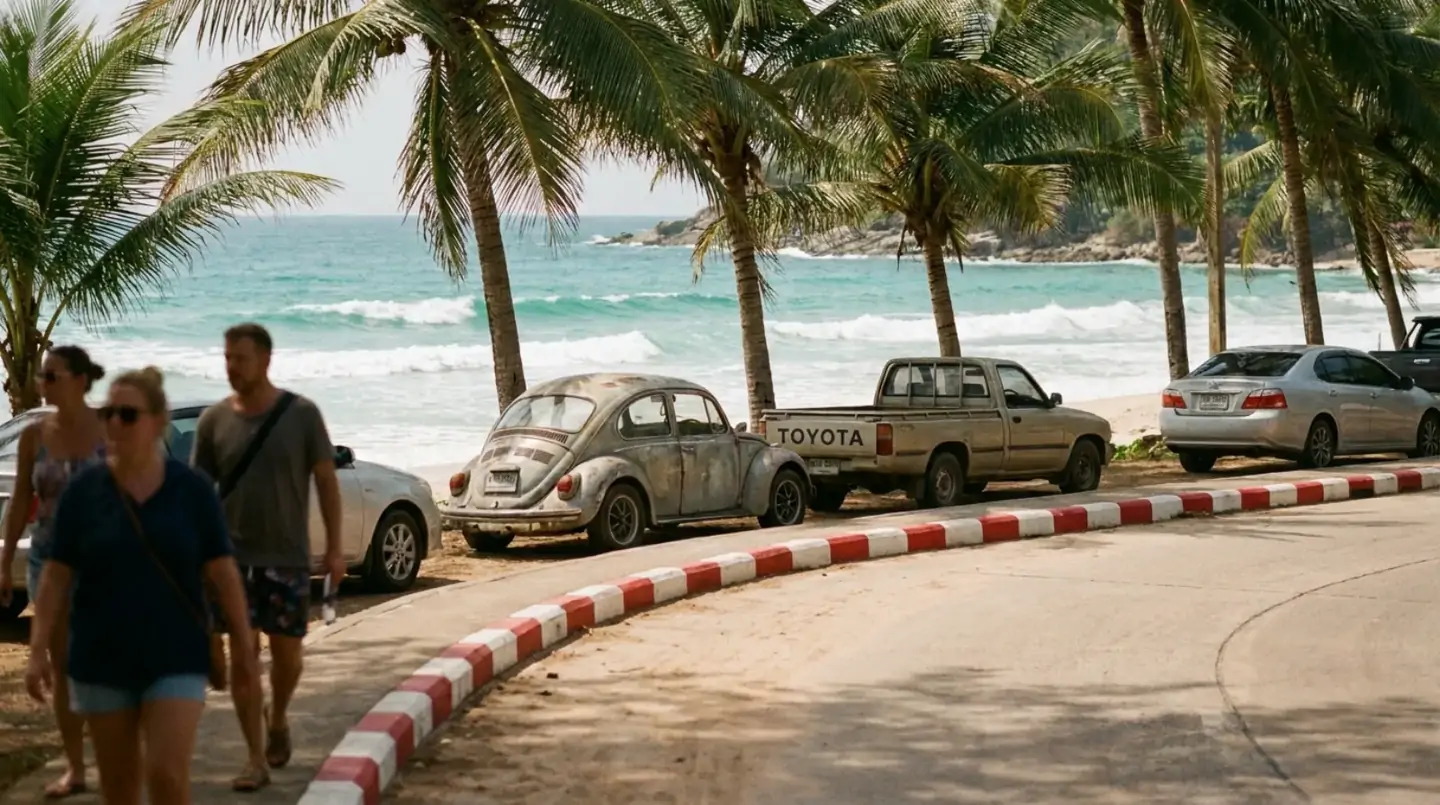
Small town temples have no forecourt at all: cars stand along the street under the ordinary rules. Kerb colour decides everything, and a red and white stripe means a prohibition enforced by removal rather than a warning.
Shade and how long you stand
Looking round a temple takes anything from twenty minutes to an hour. In that time a car on an open forecourt heats to the point where the first five minutes inside are unbearable. Shade is worth an extra hundred metres of walking, and on temple grounds there is usually some at the edges under the old trees.
Where there are animals, and monkeys live near some of the temples, fold the mirrors, close the windows completely and leave nothing in sight that resembles food or a bag. A gap of one finger is enough for them.
What to bring and how to dress
Shoulders and knees have to be covered on temple grounds, and that applies to everybody. Keeping a light cover up and longer shorts in the car is easier than solving the problem at each entrance. With the air conditioning running it is no hardship in the cabin, and it saves time at the gate.
Shoes come off before entering a building, so sandals are more convenient than trainers. Tiles baking on a temple forecourt at midday are a separate argument for going in the morning.
Water in the car is essential: the distances between points are short but you step out into the sun often, and dehydration reaches the driver's concentration before it reaches anybody's comfort.
Cash matters too, and in small notes. Some temple car parks take a fee at the entrance and there is nowhere to break a large note, with a queue behind you that does not enjoy waiting.
TipKeep small notes in the car. At several temple car parks the fee is taken in cash at the entrance, and the queue behind you will not wait while somebody finds change for a large note.
How many points really fit in a day
Three or four, within one or two neighbouring zones. Each stop is made up of the approach, the search for a space, the visit, the walk back and the exit, and that rarely fits into less than an hour even when the temple itself takes twenty minutes.
A fifth and sixth point are usually added at the expense of lunch and rest, and the day ends with a tired driver on an evening road. There is little sense in that: the temples are not going anywhere, and driving among bikes without lights is the worst part of the day.
The scheme that works in practice: set off early, two points before the heat, lunch in the shade, one point afterwards and back before the evening peak. A day like that does not exhaust anybody and leaves something in reserve for the drive home.
Add a swim or a market to the end rather than another temple. The change of pace is what makes the day memorable, and it also puts you on the road at a better hour.
If you would like a route built around where you are staying, just ask. Message us on WhatsApp with your dates and your district, or Telegram if you prefer, and we will suggest which zone to start from.
Cars for this trip
See all →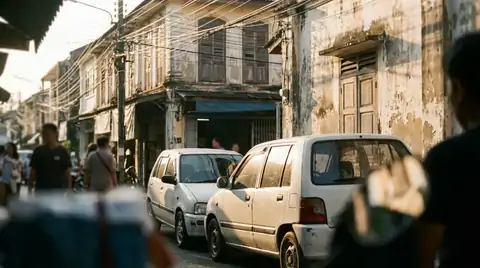
Common questions
How many temples can I visit in one day in Phuket?
Three or four is a comfortable number once parking, walking and the exits are counted. Each stop rarely takes less than an hour in total, even when the temple itself is seen in twenty minutes.
What should I wear to visit a temple?
Shoulders and knees covered, which applies to everyone regardless of the heat. Keep a light cover up and longer shorts in the car, and wear sandals, since shoes come off before entering a building.
Is parking difficult at Phuket's temples?
The larger ones have marked forecourts that fill by midday, and the difficulty is leaving rather than arriving once cars park tightly behind you. Small town temples have no forecourt at all, so the kerb colour decides where you can stand.
Is the drive up to the hilltop statue hard?
The climb is fine in any car, but the descent is several kilometres of continuous gradient that heats the brakes. Come down in a low gear with short applications of the pedal rather than holding it all the way.
What is the best time of day for a temple route?
Early morning, because the forecourts are empty, the tiles are not yet baking and the roads are clear. It also lets you finish before the evening peak, which is the part of the day worth avoiding on this island.
Write to us — we will find the right car
We answer in chat: no forms, no phone calls, no waiting on hold.